On January 2nd 2021 in Jakarta, the Earth reached perihelion or its closest distance from the Sun. Figure 1 shows the situation:
Figure 2 shows the times and distances when the Earth is at perihelion and aphelion (its furthest distance from the Sun).
The same
source has this to say about the Earth's orbit:
The Earth orbits the Sun in an elliptical path, which means that there is one point on the path closest to the Sun and one point that is farthest away from the Sun. This path's shape varies due to the gravitational influences of other planetary objects, particularly the Moon. Approximately every 100,000 years, the Earth's orbital path changes from being nearly circular to elliptical. The difference of the Earth’s orbital shape from a perfect circle is known as its eccentricity. An eccentricity value of 0 is a circular orbit, while values between 0 and 1 describe an elliptical orbit.
The Earth is closest to the Sun, or at the perihelion, about two weeks after the December solstice, when it is winter in the Northern Hemisphere. Conversely, the Earth is farthest away from the Sun, at the aphelion point, two weeks after the June solstice, when the Northern Hemisphere is enjoying warm summer months.
Due to variations in the eccentricity of the Earth's orbit, the dates when the Earth reaches its perihelion or aphelion are not fixed. In 1246, the December Solstice was on the same day as the Earth reached its perihelion. Since then, the perihelion and aphelion dates have drifted by a day every 58 years. In the short-term, the dates can vary up to two days from one year to another. Mathematicians and astronomers estimate that in 6430, over 4000 years from now, the perihelion will coincide with the March equinox.
The prefixes peri (meaning near) and apo (meaning far) are attached a root such as helion (meaning the Sun) to form the words perihelion and aphelion (with the 'o' in apo omitted in this case). A planet's closest and furthest approaches to the Sun are termed its perihelion and aphelion. However, the same prefixes are applied to the root gee (meaning Earth) to form perigee and apogee. These terms are typically applied to the Moon closest and furthest approaches to Earth, also they can be used for the approaches of other moons to the planets around which they orbit.
In general, apsis is used to describe the two extreme points in an elliptical orbit. See Figure 4.
The terms periapsis and apoapsis as distances, referring to the smallest and largest distances between the orbiter and its host body. However, things can get complicated when the differences in sizes between two bodies is not too great. See Figure 5 which shows the barycentre, or centre of mass, is the point about which both bodies orbit in a two-body system.
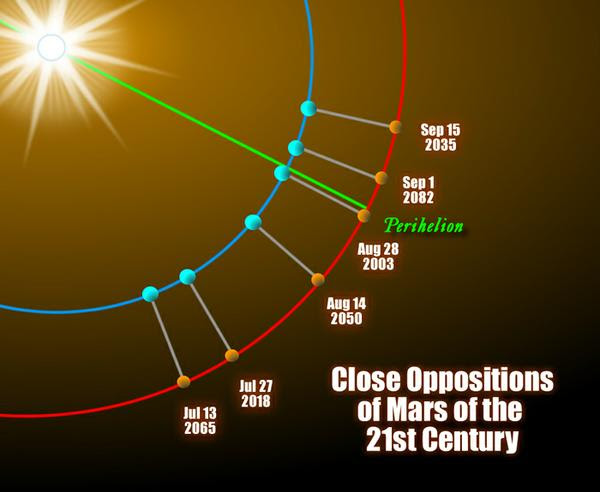
So how does this relate to astrology? It's difficult to say. The perihelion of Mars brings it close to the Earth when the Sun, Earth and Mars form a line. See Figure 6:
The closest approaches occur when three events line up:
- Earth passes between Mars and the Sun
- Mars is near its perihelion or closest point to the Sun
- Earth is near its aphelion or farthest point from the Sun
This leads to some interesting cycles:
Close (or distant) oppositions of Mars recur in periods of 15 to 17 years. Note that we’re now 17 years past the historically close encounter on August 28, 2003. Mars’ next extra-close opposition will be September 15, 2035. However, like the 2018 opposition, it won’t be quite as close as the opposition of August 2003. Very similar Martian oppositions take place every 79 years (15 + 17 + 15 + 17 + 15 = 79). These 79-year cycles repeat with only a delay of two to five calendar days.
The super-close opposition of Mars in the year 2082 will fall on September 1, 2082. But once again, Earth and Mars won’t come as close as they did in August 2003. There is a more exact cycle of 284 years (79 + 79 + 79 + 15 + 17 + 15 = 284). The Martian opposition that comes 284 years after August 28, 2003, will fall on August 29, 2287. This time around, Mars will come closer to Earth than it did during its close encounter in August 2003.
Because the Martian orbit is becoming more eccentric (flatter), the closest oppositions will actually come closer to Earth, and the farthest oppositions will actually become more distant. The computational wizard Jean Meeus figures that from the years 0 to 3000 A.D., Mars will come closest to Earth on September 8, 2729 (55.65 million kilometres or 34.57 million miles) and farthest away on March 6, 2832 (101.50 million kilometres or 63 million miles). I’d like to see that, wouldn’t you? Source
From an astrological and thus geocentric perspective, these close approaches of Earth to Mars appear as Mars opposition the Sun. Similarly, when Mars is farthest away, it is conjunct the Sun. Are these oppositions stronger when Mars is marginally closer to the Earth and are the conjunctions weaker when Mars is marginally farther away from the Earth. Probably not. The super-close approach of Mars to Earth in August 2003 occurred in Jakarta shortly after midnight on the 29th. See Figure 7.
 |
Figure 7: created by myself using Astrolog |
Looking back at this date and around this date, nothing particularly Martian seems to have happened. Skype was released on August 29th 2003.
Even though perihelion and aphelion may lack apparent astrological significance, it's always important to be aware of these astronomical events in case some significance does emerge.


.png)