Astrological Meanderings: apogee
Showing posts with label apogee. Show all posts

Monday, 4 January 2021

Perihelion and Aphelion

On January 2nd 2021 in Jakarta, the Earth reached perihelion or its closest distance from the Sun. Figure 1 shows the situation:

Figure 1: source

Figure 2 shows the times and distances when the Earth is at perihelion and aphelion (its furthest distance from the Sun).

Figure 2: source

The same source has this to say about the Earth's orbit:
The Earth orbits the Sun in an elliptical path, which means that there is one point on the path closest to the Sun and one point that is farthest away from the Sun. This path's shape varies due to the gravitational influences of other planetary objects, particularly the Moon. Approximately every 100,000 years, the Earth's orbital path changes from being nearly circular to elliptical. The difference of the Earth’s orbital shape from a perfect circle is known as its eccentricity. An eccentricity value of 0 is a circular orbit, while values between 0 and 1 describe an elliptical orbit.

The Earth is closest to the Sun, or at the perihelion, about two weeks after the December solstice, when it is winter in the Northern Hemisphere. Conversely, the Earth is farthest away from the Sun, at the aphelion point, two weeks after the June solstice, when the Northern Hemisphere is enjoying warm summer months.

Due to variations in the eccentricity of the Earth's orbit, the dates when the Earth reaches its perihelion or aphelion are not fixed. In 1246, the December Solstice was on the same day as the Earth reached its perihelion. Since then, the perihelion and aphelion dates have drifted by a day every 58 years. In the short-term, the dates can vary up to two days from one year to another. Mathematicians and astronomers estimate that in 6430, over 4000 years from now, the perihelion will coincide with the March equinox.

The prefixes peri (meaning near) and apo (meaning far) are attached a root such as helion (meaning the Sun) to form the words perihelion and aphelion (with the 'o' in apo omitted in this case). A planet's closest and furthest approaches to the Sun are termed its perihelion and aphelion. However, the same prefixes are applied to the root gee (meaning Earth) to form perigee and apogee. These terms are typically applied to the Moon closest and furthest approaches to Earth, also they can be used for the approaches of other moons to the planets around which they orbit.

In general, apsis is used to describe the two extreme points in an elliptical orbit. See Figure 4.

Figure 4: source

The terms periapsis and apoapsis as distances, referring to the smallest and largest distances between the orbiter and its host body. However, things can get complicated when the differences in sizes between two bodies is not too great. See Figure 5 which shows the barycentre, or centre of mass, is the point about which both bodies orbit in a two-body system.

Figure 5: source

So how does this relate to astrology? It's difficult to say. The perihelion of Mars brings it close to the Earth when the Sun, Earth and Mars form a line. See Figure 6:


Figure 6: source

The closest approaches occur when three events line up:

  • Earth passes between Mars and the Sun
  • Mars is near its perihelion or closest point to the Sun
  • Earth is near its aphelion or farthest point from the Sun

This leads to some interesting cycles:

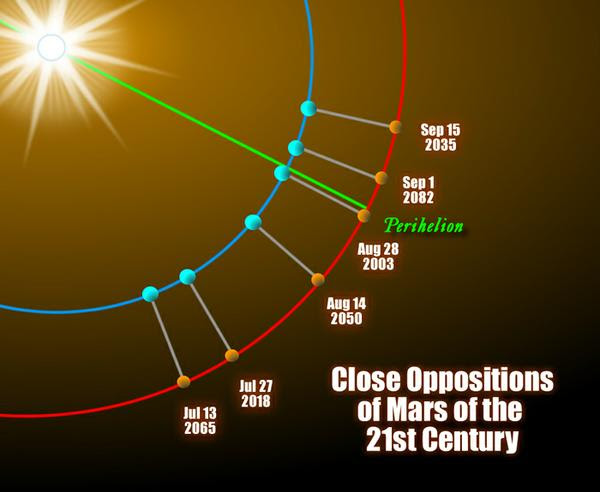
Close (or distant) oppositions of Mars recur in periods of 15 to 17 years. Note that we’re now 17 years past the historically close encounter on August 28, 2003. Mars’ next extra-close opposition will be September 15, 2035. However, like the 2018 opposition, it won’t be quite as close as the opposition of August 2003. Very similar Martian oppositions take place every 79 years (15 + 17 + 15 + 17 + 15 = 79). These 79-year cycles repeat with only a delay of two to five calendar days. 
The super-close opposition of Mars in the year 2082 will fall on September 1, 2082. But once again, Earth and Mars won’t come as close as they did in August 2003. There is a more exact cycle of 284 years (79 + 79 + 79 + 15 + 17 + 15 = 284). The Martian opposition that comes 284 years after August 28, 2003, will fall on August 29, 2287. This time around, Mars will come closer to Earth than it did during its close encounter in August 2003. 
Because the Martian orbit is becoming more eccentric (flatter), the closest oppositions will actually come closer to Earth, and the farthest oppositions will actually become more distant. The computational wizard Jean Meeus figures that from the years 0 to 3000 A.D., Mars will come closest to Earth on September 8, 2729 (55.65 million kilometres or 34.57 million miles) and farthest away on March 6, 2832 (101.50 million kilometres or 63 million miles). I’d like to see that, wouldn’t you? Source

From an astrological and thus geocentric perspective, these close approaches of Earth to Mars appear as Mars opposition the Sun. Similarly, when Mars is farthest away, it is conjunct the Sun. Are these oppositions stronger when Mars is marginally closer to the Earth and are the conjunctions weaker when Mars is marginally farther away from the Earth. Probably not. The super-close approach of Mars to Earth in August 2003 occurred in Jakarta shortly after midnight on the 29th. See Figure 7.


Figure 7: created by myself using Astrolog

Looking back at this date and around this date, nothing particularly Martian seems to have happened. Skype was released on August 29th 2003.

Even though perihelion and aphelion may lack apparent astrological significance, it's always important to be aware of these astronomical events in case some significance does emerge.

Saturday, 4 August 2018

Mars: A Close Approach and Retrograde Motion of Planets

Figure 1
In 2018, Mars will appear brightest from July 27 to July 30. Its closest approach to Earth is July 31. That is the point in Mars' orbit when it comes closest to Earth. Mars will be at a distance of 57.6 million kilometres ... In 2003, Mars made its closest approach to Earth in nearly 60,000 years! It won't be that close again until the year 2287. Source.
Of course, Astrology doesn't take these close encounters of Mars or any other planet into account at all. The astrological chart is only concerned with a planet's celestial longitude or the angular distance of a planet east of the vernal equinox, measured along the ecliptic. Thus on July 31st at 4:33pm in Brisbane, Mars was in 3°02' of Aquarius or 303°02' east of the vernal equinox. It's celestial latitude was 6°33' South but this is not considered in chart analysis as far as I know.

Should the proximity of Mars to Earth be considered in chart analysis? Will Mars be more influential in the charts of persons who were born on July 31st 2018 compared with charts where Mars is at a maximum distance from Earth? Is a transit of Mars more powerful when it is closer to Earth than when it is farther away? I really don't know. However, what is known is that Mars is opposition to the Sun during such encounters and there is always period of time in which Mars appears to move backward through the zodiac because Earth is "overtaking" Mars because of the latter's slower orbital velocity. Mars is retrograde in Aquarius and Capricorn from June 26th to August 27th, 2018. Figure 2 shows this.

Figure 2 
In general, Mars is retrograde approximately 58-81 days every 2+ years. Cafe Astrology. com makes the following observation about a retrograde Mars in the natal chart:
If Mars is retrograde in the natal chart, this is what the Karmic Insight report has to say about this position: “Asserting yourself vigorously and directly is complicated by the fact that you had a prior lifetime or lifetimes in which aggression was either misused (by you, or against you) and/or all personal initiative and self-will was insistently discouraged (perhaps due to a belief system that advocated passivity). 
In any case, the message that was impressed upon you was that forceful action is wrong or dangerous. Thus, if you stand up for yourself, you now tend to hesitate, back down or even be plagued with fears of retaliation.”
Most natal charts will thus not have Mars retrograde. In 90% or more of natal charts, Mars will be in direct motion. This got me thinking about the periods of retrograde motion of other planets. Cafe Astrology. com has a lot to say about Mercury retrograde, a phenomenon that occurs approximately three times a year for approximately three weeks each time. Here is a quick quote:
When Mercury is retrograde in the natal chart itself, the thinking processes are generally more acute, and the sense of humour rather quirky. People with Mercury retrograde take in information differently than those with Mercury direct in their natal charts. How many people are born with a retrograde Mercury? Roughly 18%. 
Venus appears to retrograde approximately 40-43 days out of every 18 months or around 7-8% of its orbit.  How does a retrograde Venus affect a natal chart? Again Cafe Astrology. com has a lot to say about this. Here is an excerpt:
When Venus is retrograde in the natal chart itself, the feeling nature is deep. Socialising is taken seriously, and rarely lightly. They can be somewhat shy in youth, as there can be an awkwardness felt concerning small talk and social graces, and an aversion for superficialities. Love is extremely important to a person with a retrograde Venus, but they may not be explicit about it enough for others to know just how deeply they can love. There is always more to this person than meets the eye. Their love life (and sometimes financial life) can be hidden in some manner.
Cafe Astrology.com has a page about retrograde motion in general in which the point is made that as we move further out with the planets, retrogrades occur more frequently, and it is more common for people to have these planets retrograde in their charts. There follows descriptions for Jupiter, Saturn, Uranus, Neptune and Pluto in retrograde motion, although no percentages for the amount of time spent retrograde. However, I discovered the following summary on Quora:

Planet --> Synodic period, days --> Synodic period, mean months --> Days in retrograde -->  %

Mercury --> 116 --> 3.8 -->   ~21 -->   18
Venus --> 584 --> 19.2 -->    41  -->     7
Mars --> 780 --> 25.6 -->     72 -->      9
Jupiter --> 399 --> 13.1 -->  121  -->    30
Saturn --> 378 --> 12.4 -->   138  -->    37
Uranus --> 370 --> 12.15 -->   151 -->    41
Neptune --> 367 --> 12.07 -->   158  -->    43

Pluto of course would be even closer to 50%. The table clearly shows that persons with Mercury, Venus and Mars retrograde are in a distinct minority and that it should be a factor to consider when interpreting natal charts.