Figure 1 shows a screenshot of a cool animation depicting the rotation, tilt and relative sizes of the planets in the solar system. Click here for the animation.
What is doesn't depict of course are the orbits of the planets, their eccentricities and the angle that these orbits make the plane formed by the Earth's orbit. Figure 2 is shows a table of eccentricities along with perihelions and aphelions (closest and furthest approaches to the Sun).
Notice how the perihelion of Pluto takes it inside the orbit of Neptune. Ceres is not listed in the table but it has an eccentricity of 0.0758 with an angle of inclination to the plane of the Earth's orbit of 10.59°. Here is a YouTube video that explains these angles inclination and is fact part of a 33 episode series on comparative planetology.
Figure 3 displays the values of these planetary inclinations:
One could well ask what is the relevance to Astrology of all this astronomical detail? Let's use the planetary orbital inclinations to address this question. The angles correspond in an astrological chart to the maximum possible celestial latitudes, both North and South, that a planet can have. Figure 4 shows today's celestial longitudes.
Figure 4: from Astrolog
As can be seen, the celestial latitude of the Sun is 0°00' as it should be because the ecliptic plane from which the angles are measured is defined by the Earth's path around the Sun. Notice how all the absolute values of all the latitudes conform with the values shown in Figure 3. The North Node of the Moon is where the Moon's orbit intersects the Ecliptic and so its value, like that of the Sun, is always 0°00'. The orbit of the Moon itself has an inclination of 5.145°. The orbit of Chiron has an eccentricity of 0.3823 and an inclination of 6.93°. Like the Moon, all the planets, centaurs, asteroids and dwarf planets have north and south nodes where their orbits intersect the plane of the ecliptic. Some astrologers take these nodes into account but most don't.
The point is that these angles are commonly displayed in an astrological chart for a reason and that is that two coordinates (celestial latitude and longitude) are needed to define an astronomical body's position. Much attention is given to the longitude. For example in Figure 4, it can be seen that Mercury is in 27°37' of Virgo. Far less attention is given to the latitude but when planets are conjunct both in terms of latitude and longitude, this aspect can be particularly potent. One has only to look back to mid-January of 2020 to realise this. See Figure 5.
Figure 5: from Astrolog
It was the spectacular conjunction in Capricorn, occurring in January 13th/14th of 2020, that marked the onset of the Covid pandemic. Notice how the positions of the Sun and Pluto differ by only 0°01' of longitude and that Pluto's latitude is -0°40' (0°40' of south latitude). Remember that Pluto's latitude ranges between -17° and +17° but at this time it was almost zero. Similarly Saturn was not only a mere 0°04' away from an exact conjunction with the Sun but it was also only 0°02' away from the plane of the ecliptic. It is the closeness, in terms of both latitude and longitude of the planets involved in this conjunction, that made it so potent. Its effects will be felt for decades to come.
All the astronomical details concerning the planets are relevant in some way astrologically. To take another example, it has always struck me how Venus, the planet of harmony, and its higher octave Neptune, both have orbits that almost perfectly circular. This means that the eccentricities of their orbits are almost zero (0.007 and 0.009 respectively). Astrologers must know their astronomy, first and foremost before anything else.
The same source has this to say about the Earth's orbit:
The Earth orbits the Sun in an elliptical path, which means that there is one point on the path closest to the Sun and one point that is farthest away from the Sun. This path's shape varies due to the gravitational influences of other planetary objects, particularly the Moon. Approximately every 100,000 years, the Earth's orbital path changes from being nearly circular to elliptical. The difference of the Earth’s orbital shape from a perfect circle is known as its eccentricity. An eccentricity value of 0 is a circular orbit, while values between 0 and 1 describe an elliptical orbit.
The Earth is closest to the Sun, or at the perihelion, about two weeks after the December solstice, when it is winter in the Northern Hemisphere. Conversely, the Earth is farthest away from the Sun, at the aphelion point, two weeks after the June solstice, when the Northern Hemisphere is enjoying warm summer months.
Due to variations in the eccentricity of the Earth's orbit, the dates when the Earth reaches its perihelion or aphelion are not fixed. In 1246, the December Solstice was on the same day as the Earth reached its perihelion. Since then, the perihelion and aphelion dates have drifted by a day every 58 years. In the short-term, the dates can vary up to two days from one year to another. Mathematicians and astronomers estimate that in 6430, over 4000 years from now, the perihelion will coincide with the March equinox.
The prefixes peri (meaning near) and apo (meaning far) are attached a root such as helion (meaning the Sun) to form the words perihelion and aphelion (with the 'o' in apo omitted in this case). A planet's closest and furthest approaches to the Sun are termed its perihelion and aphelion. However, the same prefixes are applied to the root gee (meaning Earth) to form perigee and apogee. These terms are typically applied to the Moon closest and furthest approaches to Earth, also they can be used for the approaches of other moons to the planets around which they orbit.
In general, apsis is used to describe the two extreme points in an elliptical orbit. See Figure 4.
The terms periapsis and apoapsis as distances, referring to the smallest and largest distances between the orbiter and its host body. However, things can get complicated when the differences in sizes between two bodies is not too great. See Figure 5 which shows the barycentre, or centre of mass, is the point about which both bodies orbit in a two-body system.
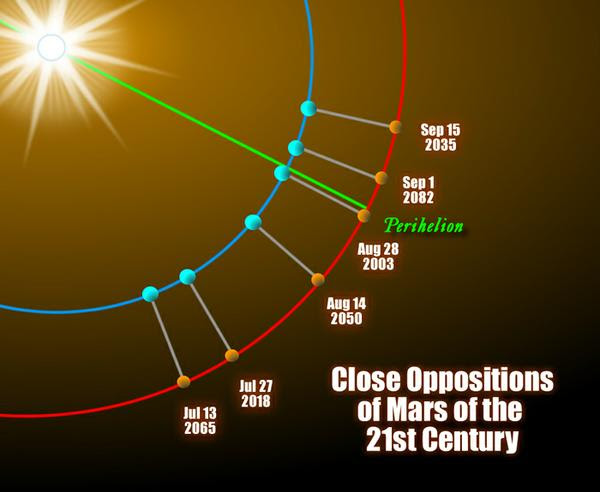
So how does this relate to astrology? It's difficult to say. The perihelion of Mars brings it close to the Earth when the Sun, Earth and Mars form a line. See Figure 6:
The closest approaches occur when three events line up:
Earth passes between Mars and the Sun
Mars is near its perihelion or closest point to the Sun
Earth is near its aphelion or farthest point from the Sun
This leads to some interesting cycles:
Close (or distant) oppositions of Mars recur in periods of 15 to 17 years. Note that we’re now 17 years past the historically close encounter on August 28, 2003. Mars’ next extra-close opposition will be September 15, 2035. However, like the 2018 opposition, it won’t be quite as close as the opposition of August 2003. Very similar Martian oppositions take place every 79 years (15 + 17 + 15 + 17 + 15 = 79). These 79-year cycles repeat with only a delay of two to five calendar days.
The super-close opposition of Mars in the year 2082 will fall on September 1, 2082. But once again, Earth and Mars won’t come as close as they did in August 2003. There is a more exact cycle of 284 years (79 + 79 + 79 + 15 + 17 + 15 = 284). The Martian opposition that comes 284 years after August 28, 2003, will fall on August 29, 2287. This time around, Mars will come closer to Earth than it did during its close encounter in August 2003.
Because the Martian orbit is becoming more eccentric (flatter), the closest oppositions will actually come closer to Earth, and the farthest oppositions will actually become more distant. The computational wizard Jean Meeus figures that from the years 0 to 3000 A.D., Mars will come closest to Earth on September 8, 2729 (55.65 million kilometres or 34.57 million miles) and farthest away on March 6, 2832 (101.50 million kilometres or 63 million miles). I’d like to see that, wouldn’t you? Source
From an astrological and thus geocentric perspective, these close approaches of Earth to Mars appear as Mars opposition the Sun. Similarly, when Mars is farthest away, it is conjunct the Sun. Are these oppositions stronger when Mars is marginally closer to the Earth and are the conjunctions weaker when Mars is marginally farther away from the Earth. Probably not. The super-close approach of Mars to Earth in August 2003 occurred in Jakarta shortly after midnight on the 29th. See Figure 7.
Figure 7: created by myself using Astrolog
Looking back at this date and around this date, nothing particularly Martian seems to have happened. Skype was released on August 29th 2003.
Even though perihelion and aphelion may lack apparent astrological significance, it's always important to be aware of these astronomical events in case some significance does emerge.
As Chiron will be entering Aries next week, on the 17th April, and will spend more than eight years in that sign, I deemed it time to look at the planet more closely. There is quite a comprehensive analysis of Chiron, from both an astronomical and astrological perspective, at the website Chiron and Friends by Zane Stein.
The first page (page 2, I don't know what happened to page 1) deals with the astronomical aspects of Chiron and the next page (page 3) looks at the astrological side of things. A subsequent page is a table of contents relating to the Centaurs (page 4) and following that (page 4a), there is a table of contents relating to the minor planets.
Looking back, Chiron last entered Aries when I was almost exactly 19 years of age, on April 1st 1968 and it didn't leave the sign until May 28th 1976. Even after that it retrograded back into Aries. Thus Chiron spent over eight years in Aries. However, it spends far less time in other signs. This is to be expected from its highly eccentric orbit (e=0.38108).
When it is furthest from the Sun and close to Uranus, Chiron is in Aries and takes about eight years to traverse that sign. However, when it is in Libra and within the orbit of Saturn, it takes less than 1.5 years to traverse that sign. Its orbital period is 50.76 years. The aphelion (furthest point from the Sun) will be reached in 2021. Here is a nice diagram that shows the orbit from a 3-D perspective:
Astrologically, part of its significance is well explained in a quote from this site:
Chiron is acknowledged to create a link between the realms of Saturn and Uranus—from the old, established, concretised, stoic realm of Saturn to the new, unconventional, radical, electrical, spontaneous realm of Uranus. As we move outward in our solar (system's) consciousness, we move from Saturn to Uranus. Uranus breaks us from the conformity of the past, opening us to new realms of possibility. Thus Chiron escorts us in this process, often helping to create the way across the Saturn-Uranus abyss. Conversely, Chiron helps to bring the new Uranian revelations to the concretised world of Saturn.
Because of its close relationship to both Saturn and Uranus, Chiron's aspects to both these planets are important. Chiron also seems to have a strong link to genetics due to advances being made in that field around the time of its discovery on November 1st 1977. Below is a glyph of Chiron showing the template used for its original design:
Here is a little more about Chiron's astrological significance:
Chiron's role is often associated with new discoveries in the health field and medicinal arts; and classically, Chiron is often called "the wounded healer", a term coined by Carl G. Jung, having been accidentally shot with a poisoned arrow by Heracles. Chiron works with the subtle resonances of neurological communication that make not only neurological functions possible, but also medical and healing modalities and technologies that incorporate subtle resonances, those transcendent to physical phenomenology (Radionics is a good example). Chiron is found to be significant in astrological charts associated with new medical discoveries, inventions, and new technologies or modalities in the heath-care field; and is often prominently placed in the charts of people involved with such discoveries and of those involved in the healing art-sciences.
In the astrological chart, Chiron can indicate where personal healing is required, where we must create and cross a vibrational bridge, where transmutation is required, and where we will find our way from our Saturnian past to our Uranian future, or to bring vibrational resonance of Uranus to change our calcified Saturnian structure. It is always helpful to look at the placement of Saturn and Uranus, and where they are in their synodic cycle, to help understand Chiron's role in an astrological chart.
Chiron’s lineage is different from the other centaurs, which may explain some of the differences between them. His father was Cronus, one of the original titans who ruled before the gods, and his mother was Philyra, a beautiful ocean nymph. Unfortunately, Cronus and Philyra were caught in the middle of their tryst by Rhea, Cronus’ wife. Disgraced, the Titan turned himself into a stallion and galloped away. Months later, when Philyra gave birth to their son, the baby’s form was half horse. Philyra was revolted by her child’s monstrous form; she abandoned him and begged the gods to transform her into another form, so that she could forget her disgrace. The gods turned her into a Linden tree.
Poor Chiron was effectively orphaned, but luck quickly turned in his favor. The radiant god Apollo found the baby and decided to take him in as his own son. He taught the orphan how to repress his animal urges and live nobly, in a way that would highlight his humanity, even his divinity. Apollo also taught the young centaur about music and medicine. Apollo’s twin sister, Artemis, approved of his project and decided to come aboard as the orphan’s foster mother. She taught him about archery and hunting.
After he grew up, the orphan made his foster parents proud by becoming a revered teacher. He was always eager to return the kindness that Apollo and Artemis had shown him, and he took on many young students of his own, including Achilles, Ajax, Heracles, Jason, Peleus, Perseus, and Theseus. In addition to his students, the centaur had biological children of his own. He was married to a nymph named Chariclo, and with her he had three daughters, Melanippe, Endeis, and Ocyrhoe, and one son, Carystus.