Astrological Meanderings: celestial longitude
Showing posts with label celestial longitude. Show all posts

Sunday, 29 August 2021

Comparative Planetology

Figure 1 shows a screenshot of a cool animation depicting the rotation, tilt and relative sizes of the planets in the solar system. Click here for the animation.


Figure 1: source

What is doesn't depict of course are the orbits of the planets, their eccentricities and the angle that these orbits make the plane formed by the Earth's orbit. Figure 2 is shows a table of eccentricities along with perihelions and aphelions (closest and furthest approaches to the Sun).

Figure 2: source

Notice how the perihelion of Pluto takes it inside the orbit of Neptune. Ceres is not listed in the table but it has an eccentricity of 0.0758 with an angle of inclination to the plane of the Earth's orbit of 10.59°. Here is a YouTube video that explains these angles inclination and is fact part of a 33 episode series on comparative planetology.


Figure 3 displays the values of these planetary inclinations:


Figure 3: source

One could well ask what is the relevance to Astrology of all this astronomical detail? Let's use the planetary orbital inclinations to address this question. The angles correspond in an astrological chart to the maximum possible celestial latitudes, both North and South, that a planet can have. Figure 4 shows today's celestial longitudes.


Figure 4: from Astrolog

As can be seen, the celestial latitude of the Sun is 0°00' as it should be because the ecliptic plane from which the angles are measured is defined by the Earth's path around the Sun. Notice how all the absolute values of all the latitudes conform with the values shown in Figure 3. The North Node of the Moon is where the Moon's orbit intersects the Ecliptic and so its value, like that of the Sun, is always 0°00'. The orbit of the Moon itself has an inclination of 5.145°. The orbit of Chiron has an eccentricity of 0.3823 and an inclination of 6.93°. Like the Moon, all the planets, centaurs, asteroids and dwarf planets have north and south nodes where their orbits intersect the plane of the ecliptic. Some astrologers take these nodes into account but most don't.

The point is that these angles are commonly displayed in an astrological chart for a reason and that is that two coordinates (celestial latitude and longitude) are needed to define an astronomical body's position. Much attention is given to the longitude. For example in Figure 4, it can be seen that Mercury is in 27°37' of Virgo. Far less attention is given to the latitude but when planets are conjunct both in terms of latitude and longitude, this aspect can be particularly potent. One has only to look back to mid-January of 2020 to realise this. See Figure 5.


Figure 5: from Astrolog

It was the spectacular conjunction in Capricorn, occurring in January 13th/14th of 2020, that marked the onset of the Covid pandemic. Notice how the positions of the Sun and Pluto differ by only 0°01' of longitude and that Pluto's latitude is -0°40' (0°40' of south latitude). Remember that Pluto's latitude ranges between -17° and +17° but at this time it was almost zero. Similarly Saturn was not only a mere 0°04' away from an exact conjunction with the Sun but it was also only 0°02' away from the plane of the ecliptic. It is the closeness, in terms of both latitude and longitude of the planets involved in this conjunction, that made it so potent. Its effects will be felt for decades to come.

All the astronomical details concerning the planets are relevant in some way astrologically. To take another example, it has always struck me how Venus, the planet of harmony, and its higher octave Neptune, both have orbits that almost perfectly circular. This means that the eccentricities of their orbits are almost zero (0.007 and 0.009 respectively). Astrologers must know their astronomy, first and foremost before anything else.

Tuesday, 4 June 2019

Financial Reset

I made the following post and then realised that I'd earlier made a post titled Saturn and Pluto Synodic Cycle  late last year. No matter. In the earlier post I'd focused on Basel whereas in this post I've considered London instead. While there is some overlap, the latest post has some alternative and additional information. It also indicates that the conjunction has been on my mind for some time now.

It seems that the role assigned Donald Trump by his Zionist overlords is to destabilise the world's economic system via trade wars and military tensions. The world economy of course has been in parlous shape since 2008 and it's surprising that the wheels haven't fallen off before now. There must be a major financial reset in the very near future and what better time to trigger it than amidst economic chaos and threats of war.

Israel has never had a US president so compliant to its every demand and it will make full use of him for the remainder of his term in office. With US presidential elections at the end of 2020, a meltdown of the global economy should be expected before then along with a new economic order. The conjunction of Saturn and Pluto in Capricorn in mid-January of 2020 is the strongest indicator that I can see for such a development.

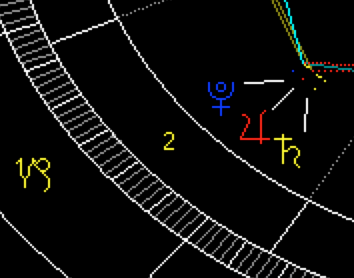
I've drawn up a chart for London as the day dawns on Monday, January 13th 2020. The conjunction falls on the Sunday but global markets won't be open then and trading will begin in London later that morning. I've chosen London because historically it was the centre of the world economy and it still plays a very important role. Figure 1 shows a dramatic chart with Mercury, Sun, Saturn and Pluto all conjunct on the rising degree.

Figure 1: dawn in London on January 13th 2020

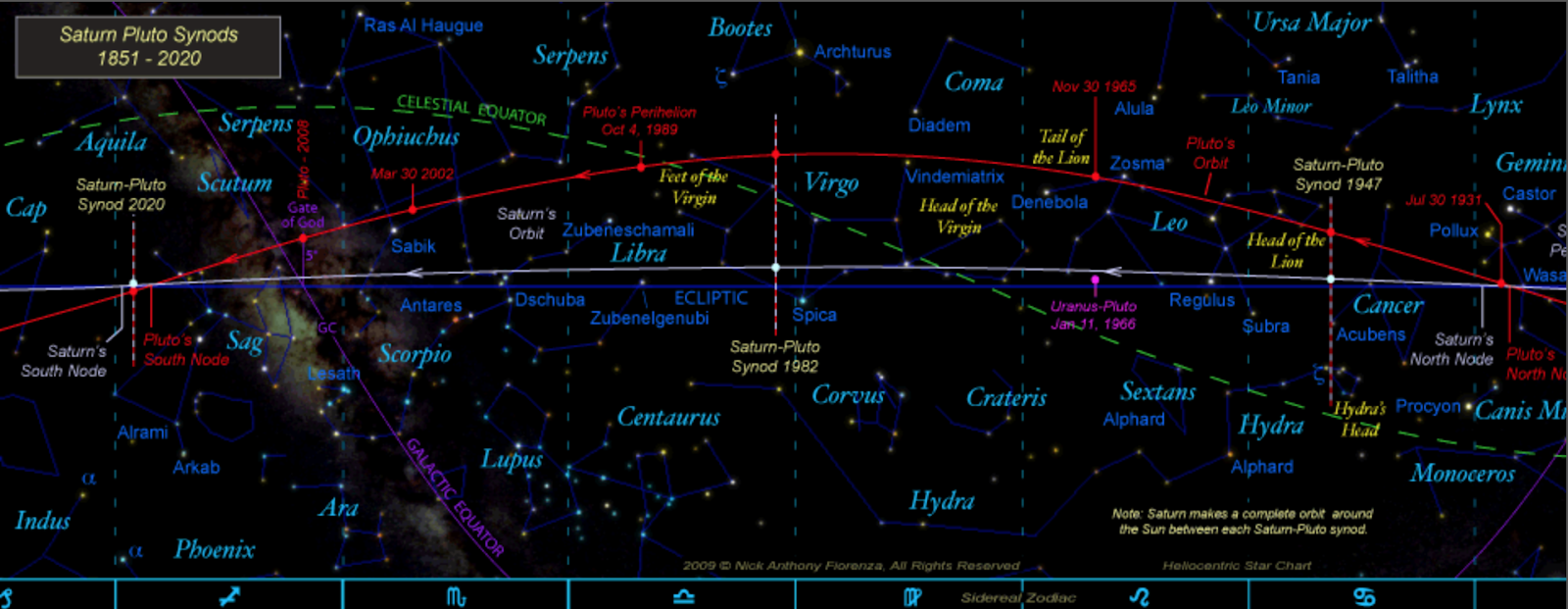
Interestingly in late November of 2020, Jupiter, Saturn and Pluto will be closely aligned in Capricorn. The involvement of Jupiter suggests some sort of new direction following the destruction by Pluto of the old economic order, represented by Saturn in Capricorn. However, getting back to the actual conjunction, it should be noted that the latitudes of the two planets are also very close, Saturn being 0°40’ S and Pluto being 0°02’ N. That's a separation of only 0°42'. This should add potency to the conjunction. This can be seen clearly in Figure 2 (taken from this site) in which the proximity of the two planets in terms of both celestial latitude and longitude can be clearly seen. Pluto can move quite some distance north and south of the celestial equator

Figure 2

It's interesting to look back of the last conjunction of these two planets. Figure 2 shows an excerpt from an article about these conjunctions:


There is quite a detailed historic examination of Saturn-Pluto interactions at this site titled:

Synodic Astrology
The Saturn-Pluto Synodic Cycles
A Historical Exploration
1851 - 2020

This is an exploration of the historical events occurring in the previous Saturn-Pluto Synodic Cycles and during the primary phase transitions occurring within those cycles, including the Saturn-Pluto square of 2009-2010.

Saturday, 4 August 2018

Mars: A Close Approach and Retrograde Motion of Planets

Figure 1
In 2018, Mars will appear brightest from July 27 to July 30. Its closest approach to Earth is July 31. That is the point in Mars' orbit when it comes closest to Earth. Mars will be at a distance of 57.6 million kilometres ... In 2003, Mars made its closest approach to Earth in nearly 60,000 years! It won't be that close again until the year 2287. Source.
Of course, Astrology doesn't take these close encounters of Mars or any other planet into account at all. The astrological chart is only concerned with a planet's celestial longitude or the angular distance of a planet east of the vernal equinox, measured along the ecliptic. Thus on July 31st at 4:33pm in Brisbane, Mars was in 3°02' of Aquarius or 303°02' east of the vernal equinox. It's celestial latitude was 6°33' South but this is not considered in chart analysis as far as I know.

Should the proximity of Mars to Earth be considered in chart analysis? Will Mars be more influential in the charts of persons who were born on July 31st 2018 compared with charts where Mars is at a maximum distance from Earth? Is a transit of Mars more powerful when it is closer to Earth than when it is farther away? I really don't know. However, what is known is that Mars is opposition to the Sun during such encounters and there is always period of time in which Mars appears to move backward through the zodiac because Earth is "overtaking" Mars because of the latter's slower orbital velocity. Mars is retrograde in Aquarius and Capricorn from June 26th to August 27th, 2018. Figure 2 shows this.

Figure 2 
In general, Mars is retrograde approximately 58-81 days every 2+ years. Cafe Astrology. com makes the following observation about a retrograde Mars in the natal chart:
If Mars is retrograde in the natal chart, this is what the Karmic Insight report has to say about this position: “Asserting yourself vigorously and directly is complicated by the fact that you had a prior lifetime or lifetimes in which aggression was either misused (by you, or against you) and/or all personal initiative and self-will was insistently discouraged (perhaps due to a belief system that advocated passivity). 
In any case, the message that was impressed upon you was that forceful action is wrong or dangerous. Thus, if you stand up for yourself, you now tend to hesitate, back down or even be plagued with fears of retaliation.”
Most natal charts will thus not have Mars retrograde. In 90% or more of natal charts, Mars will be in direct motion. This got me thinking about the periods of retrograde motion of other planets. Cafe Astrology. com has a lot to say about Mercury retrograde, a phenomenon that occurs approximately three times a year for approximately three weeks each time. Here is a quick quote:
When Mercury is retrograde in the natal chart itself, the thinking processes are generally more acute, and the sense of humour rather quirky. People with Mercury retrograde take in information differently than those with Mercury direct in their natal charts. How many people are born with a retrograde Mercury? Roughly 18%. 
Venus appears to retrograde approximately 40-43 days out of every 18 months or around 7-8% of its orbit.  How does a retrograde Venus affect a natal chart? Again Cafe Astrology. com has a lot to say about this. Here is an excerpt:
When Venus is retrograde in the natal chart itself, the feeling nature is deep. Socialising is taken seriously, and rarely lightly. They can be somewhat shy in youth, as there can be an awkwardness felt concerning small talk and social graces, and an aversion for superficialities. Love is extremely important to a person with a retrograde Venus, but they may not be explicit about it enough for others to know just how deeply they can love. There is always more to this person than meets the eye. Their love life (and sometimes financial life) can be hidden in some manner.
Cafe Astrology.com has a page about retrograde motion in general in which the point is made that as we move further out with the planets, retrogrades occur more frequently, and it is more common for people to have these planets retrograde in their charts. There follows descriptions for Jupiter, Saturn, Uranus, Neptune and Pluto in retrograde motion, although no percentages for the amount of time spent retrograde. However, I discovered the following summary on Quora:

Planet --> Synodic period, days --> Synodic period, mean months --> Days in retrograde -->  %

Mercury --> 116 --> 3.8 -->   ~21 -->   18
Venus --> 584 --> 19.2 -->    41  -->     7
Mars --> 780 --> 25.6 -->     72 -->      9
Jupiter --> 399 --> 13.1 -->  121  -->    30
Saturn --> 378 --> 12.4 -->   138  -->    37
Uranus --> 370 --> 12.15 -->   151 -->    41
Neptune --> 367 --> 12.07 -->   158  -->    43

Pluto of course would be even closer to 50%. The table clearly shows that persons with Mercury, Venus and Mars retrograde are in a distinct minority and that it should be a factor to consider when interpreting natal charts.

Wednesday, 14 February 2018

Limitations of the 2-D Horoscope

While looking at the current zodiacal position at Sirius using Astrolog, I was surprised to find that it was conjunct Canopus. These two brightest stars in the night sky are quite separate and yet they appear together in the two dimensional wheel generated by the astrology program. The reason of course is that the celestial longitudes of the two stars are being considered and their celestial latitudes, while being displayed by the program, cannot be represented on the chart. Here is the situation as displayed by Astrolog:


The information on the right shows that Canopus has a latitude of -75˚49' and Sirius has a latitude of -39˚36'. However, the view using Stellarium drives home how far apart the two stars really are (the red line represents the ecliptic, the blue line represents the celestial equator):


A planet, moving as it does close to ecliptic, will reach the same longitude as Canopus at some point in time and the two will then be deemed to be conjunct. This seems silly. I think such stars as Sirius and Canopus, because of their large latitudes, should not be included in an astrological chart and of course for the most part they aren't. The stars of the zodiacal constellations however, are a different matter. I covered the astrological significance of the big four (Regulus, Fomalhaut, Antares and Aldebaran) in an earlier post on the fixed stars.

I'm wondering if there is an effective way of representing latitude on an astrological chart. I've made an initial attempt of such a chart. It's just a crude beginning, but a beginning nonetheless. It shows a conjunction of Jupiter and Saturn with the dot positions giving a rough idea of the latitude separation of the two planets. Saturn is about 2 degrees north latitude and Jupiter is about 3 degrees south latitude. It also shows two stars that are conjunct in terms of longitude (like Canopus and Sirius) but quite separate in terms of latitude. The length of the line should give some indication of the magnitude of the latitude but a linear scale wouldn't work. Something logarithmic would work better. Perhaps an inner and outer dotted circle at the same distance from the green and blue circles but representing 25 degrees. 

Tuesday, 13 February 2018

Canopus

I've been taking more interest in the night sky lately and using Stellarium it's been easy to identify the major stars. In this post I'll examine some of the facts and related information about the star Canopus. In my natal chart, the star is located at 14˚16' Cancer, forming a T-square with the Sun and Neptune.


The only problem with this placement is that Canopus is nowhere near the ecliptic and needs to be mapped on to it by drawing an arc from its position in the sky that meets the ecliptic at a right angle This is shown in the diagram below:


This is the problem that bedevils the two dimensional horoscope. The ecliptic is the backbone of a chart but only rarely are astronomical objects located exactly on it. In most cases, they are at some distance from it and need to be mapped on to it as has been done for Canopus in the diagram above.

How exactly is this mapping done? Well, an astronomical object's position can be measured in terms of celestial longitude and celestial latitude. The latter shows the angular distance of the object from the ecliptic. The former measures the object's angular distance from its orthogonal projection on the ecliptic to the First Point of Aries. It is the celestial longitude of an object that is considered when placing it in the two dimensional horoscope.

This celestial latitude however, is displayed in the Astrolog chart. For example, in my natal chart shown earlier, the longitude of Canopus can be read to the right of the longitude. It is -75°50', the negative sign indicating south latitude. Stellarium also shows this information but from a topocentric rather than geocentric perspective. The difference between these two positions would be very slight for fixed stars but would be most significant for the Moon. The magnitude of the difference for the Moon will be explored in a future post. Stellarium shows that the latitude of Canopus tonight, 14th February 2018 at 8:38pm, is -75°49'25.4" and its longitude is 105°13'31.1" (or 15°13'31.1" Cancer).

Here are some interesting astronomical facts about Canopus (from Wikipedia):
  • it is the brightest star in the southern constellation of Carina (Alpha Carinae)
  • it is the second-brightest star in the night-time sky, after Sirius
  • it is 310 light years distant
  • it has a radius 71 times that of the Sun
  • it is a circumpolar star when seen from points with latitude south of 37°18' S
  • its northern limit of visibility is latitude 37°18' N
Here is a shot of Canopus as it appears in Stellarium:


The constellation Carina is described as follows in Wikipedia:
Carina is a constellation in the southern sky. Its name is Latin for the keel of a ship, and it was formerly part of the larger constellation of Argo Navis (the ship Argo) until that constellation was divided into three pieces, the other two being Puppis (the poop deck), and Vela (the sails of the ship).
Carina was once a part of Argo Navis, the great ship of Jason and the Argonauts who searched for the Golden Fleece. The constellation of Argo was introduced in ancient Greece. However, due to the massive size of Argo Navis and the sheer number of stars that required separate designation, Nicolas Louis de Lacaille divided Argo into three sections in 1763, including Carina (the keel). In the 19th century, these three became established as separate constellations, and were formally included in the list of 88 modern IAU constellations in 1930. Lacaille kept a single set of Greek letters for the whole of Argo, and separate sets of Latin letter designations for each of the three sections. Therefore, Carina has the α, β and ε, Vela has γ and δ, Puppis has ζ, and so on.
Here's some information about the astrological significance of Canopus (source):
Astrologically, the keywords for Canopus, the keel, are: the navigator and the pathfinder and it is linked to the story of the Argo and the rescue of Helen of Troy but there is much more to Canopus. When linked to natal planets, Ptolemy associated the star with Saturn and Jupiter, Robson with 'piety, conservatism, and turning evil into good'. Ebertin connects Canopus to 'a love of travel' while Rigor adds the more negative potential of 'domestic problems'. 
(Ex: if the natal planet linked to Canopus is fussy Mars, the potential for domestic problems would be more likely to occur due to conflicts and quarrels.)
Some cultures, including certain Native American tribes, linked the precession of Canopus with timing the end of the world, and other ancient cultures considered it the weight at the end of the plumb line that defined earth's poles so that the plumb line's movement explained the effects of precession on Canopus, sometimes known as the Point of Stillness in the south. Plus, the star was once worshiped in desert cultures as the Star of Egypt (instead of Sirius!) and in China, the red star is associated with happiness, success, and a long life which makes it the Star of Old Age. 
For as Brady's Book of Fixed Stars relates, "In about 6,000 B.C.E. {Canopus} was the heliacal rising star for the autumn equinox and a series of temples were built in Egypt in alignment with these risings. Modern people see this star now being claimed by NASA, as they use this ancient location point as a navigational aid for spacecraft." Canopus--still the navigator! 
In natal horoscopes, Canopus (14 Cancer) is a powerful star which can provide leadership skills. New directions may be inspired by Canopus which acts in similar fashion as the royal stars which always include a 'caution' (ex: royal Regulus: success if revenge is avoided--otherwise all gains will be lost). With Canopus linked to a natal chart, success is possible but its caution lies within the flaw of needing too much control.