Astrological Meanderings: pluto
Showing posts with label pluto. Show all posts

Thursday, 1 May 2025

Saturn Enters Aries

Well, the time has come ... almost. On May 25th, transiting Saturn will enter Aries but before that Pluto will turn retrograde in Aquarius on May 5th. However, it will not reenter Capricorn but station in 1°22' on October 13th 2025 before moving forward again. This retrograde period will probably see a renewed resistance on the part of governments and the ruling elite to the societal transformations that Pluto is stimulating before this resistance weakens in the face of Pluto's renewed forward momentum after mid-October.

The entry of Saturn into Aries and its conjunction with Neptune will also dampen the fiery (Aries) idealism (Neptune) driving societal change as more control mechanisms are put into place. Ultimately, Neptune will dissolve the boundaries that Saturn will try to impose but there may be considerable repression in the short term. Remember that Neptune will spend far longer than Saturn in the sign of Aries. Unlike Pluto, transiting Saturn will later retrograde and reenter Pisces on September 2nd 2025. It will return to Aries on February 14th 2026.

Monday, 20 March 2023

Pluto in Pisces

I watched an interesting video on YouTube in which remote viewing of the future was discussed. Here is a link to it. One prediction that struck me was that there would be a major event or series of events between 2040 and 2045 that would have profound effect on the planet and its inhabitants. People decades later would still be getting over it. 

With a lot of astrological focus being on Pluto entering Aquarius, it occurred to me to look at when Pluto enters Pisces because this would mark a dissolution of the existing order in preparation for the planet's entry into Aries. Figure 1 shows a table of Pluto's movements over the coming decades.


Figure 1: source

As can be seen, Pluto first enters Pisces in March of 2043. It stays there until September of the same year before retrograding into Aquarius. It enters Pisces again in January of 2044 and remains there until June of 2066. I probably won't be around to experience whatever happens. It's now March of 2023 and I'm approaching my 74th birthday. In March of 2043, I'd be approaching my 94th birthday. My grandfathers, maternal and paternal, survived to around that age so it's possible I guess. 

It's interesting to speculate what the nature of the upheavals might be in 2040 to 2045 and the video mentioned earlier doesn't reveal much. I'll see if I can find out more details that might have been revealed by other remote viewers. Figure 2 shows a chart for Pluto's entry into Pisces on March 9th 2043.


Figure 2: generated by Astrolog

Perhaps I'll have more to say about this later.

Tuesday, 14 March 2023

More About Pluto in Aquarius

A year ago, in a post titled Pluto in Aquarius, I wrote the following in reference to Pluto's entry into Aquarius on March 24th 2023:

Pluto will remain in Aquarius only until June 11th 2023. It's return to Capricorn may mark a lull in the pace of change but when Pluto returns to Aquarius on January 21st 2024, to begin its twenty-year passage through the sign, the pace of change will accelerate and the technocratic dream will move closer and closer to reality.

This is not entirely accurate because, even though Pluto does reenter Aquarius on the date stated, it retrogrades to Capricorn yet again from September 1st 2024 until November 19th 2024. Once it reenters Aquarius, it will remain in that sign until 2043.


Dates may be a day off due to time zones

I also make the following observation in that post about Saturn's entry into Pisces on March 8th 2023:
... when Pluto enters Aquarius in March of 2023, Saturn has already entered Pisces. It will remain in Pisces until it enters Aries on May 25th 2025.  That two year period should mark a dissolution of many of the old systems and structures of the past as Pluto wipes the slate clean so that humanity can enter a technocratic utopia or dystopia, depending on your point of view.

In a later post in October of 2022 titled More About Pluto's Peregrinations, I wrote:

Getting back to Pluto's astrological significance, the great conjunction of mid-January 2020 that kicked the whole scamdemic nightmare involved the Sun, Ceres, Mercury, Saturn and Pluto. Clearly Saturn and Pluto are the long term players here and remarkably, given the divergence of the latter from the plane of the ecliptic, the latitudes were almost the same (+0°02' and -0°40' respectively) at the time of conjunction. The synodic cycle of the two planets is about 38 years and so the semi-square and square will be significant as well as the entry of Pluto into Aquarius.

Should we consider the semi-square of Saturn to the original conjunction point or should we consider the relative positions between the transiting Saturn and transiting Pluto. Probably both are significant. On June 17th of 2023, Saturn will turn stationary retrograde in 7°12' of Pisces with 7°50' of Pisces being the exact semi-square between Saturn and its original position. Pluto will enter Aquarius on March 24th of 2023 for a few short months before returning to Capricorn on June 12th 2023 ... Looking ahead I'd say that the period from March 2023 until June 2023 will be quite active as the global mafia attempts to push forward with its agenda.

Saturn will enter Pisces on March 8th 2023 which only adds more weight to the importance of the March to June period.

So far as March goes, we do seem to be getting a sneek preview of the transformations to come as some banks in the USA are collapsing and needing to be bailed out by the Fed. The movements of Pluto certainly give some idea of the rhythm of the transformation with deliberate overlap of months to show the gradual transitions.

  • March 2023 to June 2023: a sneek preview of the new system with the frailties of the old system on full display. Pluto in Aquarius.

  • June 2023 to January 2024: the old system struggles on but is clearly on life support. Pluto in Capricorn.

  • January 2024 to September 2024: the new system reveals itself more fully and the inevitable death of the old system becomes more apparent. Pluto in Aquarius.

  • September 2024 to November 2024: some changes are put on hold as a brief respite is called before the new system is rolled out. Pluto in Capricorn.

  • November 2024 onwards: it's full steam ahead now as the old structures have been fully dismantled and the new system is embraced but perhaps "thrust upon us" is a more accurate description. Pluto in Aquarius.
The new system will inevitably involve CBDCs and most people will be grateful. Months of bank collapses, lost pension funds and financial chaos will dispose people to accept the promise of a solution in the form of a CBDC. The full implications of the system will not become apparent until the programmable nature of this digital money becomes apparent. Governments will begin to apply restrictions on how the money can be spent. Fines can be imposed instantly and it will up to the individual to challenge them and try to recover the money. Accounts can be frozen without notice or justification. The more dictatorial the government, the more extreme the restrictions but all governments will exercise this power to a greater or less degree.

Tuesday, 4 October 2022

More About Pluto's Peregrinations

I want to revisit some of the points that I raised in my post of Saturday, 19th March 2022, titled Pluto in Aquarius. Before I do, it just struck me that Pluto is ocated in the middle of Leo in my natal chart and yet the planet (yes, planet) has an orbital period of 248 years. The reason of course for its rapid transit of half the tropical zodiac is its highly eccentric orbit. Here is the introductory information about Pluto from Wikipedia:

Pluto (minor-planet designation: 134340 Pluto) is a dwarf planet in the Kuiper belt, a ring of bodies beyond the orbit of Neptune. It was the first object discovered in the Kuiper belt, in 1930. It was declared the ninth planet from the Sun, though it was always the odd object out. Following the discovery of additional objects in the Kuiper belt and scattered disc starting in the 1990s, particularly the more massive dwarf planet Eris, Pluto's status as a planet was increasingly questioned. In 2006 the International Astronomical Union (IAU) formally re-defined the term planet to exclude Pluto, which was classified as a dwarf planet. (Many planetary astronomers, however, consider dwarf planets to be a category of planet.)

Pluto is the ninth-largest and tenth-most-massive known object to directly orbit the Sun. It is the largest known trans-Neptunian object by volume, by a small margin, but is slightly less massive than Eris. Like other Kuiper belt objects, Pluto is made primarily of ice and rock and is much smaller than the inner planets. Compared to Earth's moon, Pluto has only one sixth its mass and one third its volume.

Pluto has a moderately eccentric and inclined orbit, ranging from 30 to 49 astronomical units (4.5 to 7.3 billion kilometers; 2.8 to 4.6 billion miles) from the Sun. Light from the Sun takes 5.5 hours to reach Pluto at its average distance (39.5 AU [5.91 billion km; 3.67 billion mi]). Pluto's eccentric orbit periodically brings it closer to the Sun than Neptune, but a stable orbital resonance prevents them from colliding.

Pluto has five known moons: Charon, the largest, whose diameter is just over half that of Pluto; Styx; Nix; Kerberos; and Hydra. Pluto and Charon are sometimes considered a binary system because the barycenter of their orbits does not lie within either body, and they are tidally locked. The New Horizons mission was the first spacecraft to visit Pluto and its moons, making a flyby on July 14, 2015 and taking detailed measurements and observations.

The artice goes on to give some interesting information about how Pluto got its name and associated glyphs:

The name Pluto, after the Greek/Roman god of the underworld, was proposed by Venetia Burney (1918–2009), an eleven-year-old schoolgirl in Oxford, England, who was interested in classical mythology. She suggested it in a conversation with her grandfather Falconer Madan, a former librarian at the University of Oxford's Bodleian Library, who passed the name to astronomy professor Herbert Hall Turner, who cabled it to colleagues in the United States.

Each member of the Lowell Observatory was allowed to vote on a short-list of three potential names: Minerva (which was already the name for an asteroid), Cronus (which had lost reputation through being proposed by the unpopular astronomer Thomas Jefferson Jackson See), and Pluto. Pluto received a unanimous vote. The name was published on May 1, 1930. Upon the announcement, Madan gave Venetia £5 (equivalent to £336 in 2021 or US$394 in 2021 as a reward.

The final choice of name was helped in part by the fact that the first two letters of Pluto are the initials of Percival Lowell. Pluto's planetary symbol (Pluto monogram symbol.svg, Unicode U+2647: ♇) was then created as a monogram of the letters "PL", though it is rarely used in astronomy today. For example, ⟨♇⟩ occurs in a table of the planets identified by their symbols in a 2004 article written before the 2006 IAU definition, but not in a graph of planets, dwarf planets and moons from 2016, where only the eight IAU planets are identified by their symbols. Planetary symbols in general are uncommon in astronomy, and are discouraged by the IAU. 

The ♇ monogram is also used in astrology, but the most-common astrological symbol for Pluto, at least in English-language sources, is an orb over Pluto's bident. The bident symbol has seen some astronomical use as well since the IAU decision on dwarf planets, for example in a public-education poster on dwarf planets published by the NASA/JPL Dawn mission in 2015, in which each of the five dwarf planets announced by the IAU receives a symbol. There are in addition several other symbols for Pluto found in European astrological sources, including three accepted by Unicode.

The name 'Pluto' was soon embraced by wider culture. In 1930, Walt Disney was apparently inspired by it when he introduced for Mickey Mouse a canine companion named Pluto, although Disney animator Ben Sharpsteen could not confirm why the name was given. In 1941, Glenn T. Seaborg named the newly created element plutonium after Pluto, in keeping with the tradition of naming elements after newly discovered planets, following uranium, which was named after Uranus, and neptunium, which was named after Neptune.

I wasn't aware of the naming tradition mentioned in the previous paragraph. Interesting. Getting back to Pluto's astrological significance, the great conjunction of mid-January 2020 that kicked the whole scamdemic nightmare involved the Sun, Ceres, Mercury, Saturn and Pluto. Clearly Saturn and Pluto are the long term players here and remarkably, given the divergence of the latter from the plane of the ecliptic, the latitudes were almost the same (+0°02' and -0°40' respectively) at the time of conjunction. The synodic cycle of the two planets is about 38 years and so the semi-square and square will be significant as well as the entry of Pluto into Aquarius.

Should we consider the semi-square of Saturn to the original conjunction point or should we consider the relative positions between the transiting Saturn and transiting Pluto. Probably both are significant. On June 17th of 2023, Saturn will turn stationary retrograde in 7°12' of Pisces with 7°50' of Pisces being the exact semi-square between Saturn and its original position. Pluto will enter Aquarius on March 24th of 2023 for a few short months before returning to Capricorn on June 12th 2023. It will enter Aquarius again on January 21st 2024 for a much longer stay. Looking ahead I'd say that the period from March 2023 until June 2023 will be quite active as the global mafia attempts to push forward with its agenda.

Saturn will enter Pisces on March 8th 2023 which only adds more weight to the importance of the March to June period. It's interesting to look at the chart that I drew up for the conjunction at sunrise in London on January 13th 2020.


Venus in 29°28' sits on the cusp of the second house opposing the Moon in Leo on the cusp of the eighth house. Transiting Saturn will pass over Venus as it enters Pisces. Saturn will turn retrograde later in the year but will remain in Pisces, turning stationary direct in 0°30' Pisces on November 5th 2023. The significance of Saturn in Pisces of course is the dissolution of the old structures and systems that we have gotten used to over the centuries. The abolition of cash is an obvious example but more generally the imposition of Communism by stealth will accelerate since Pisces is associated with selfless, idealistic notions of making sacrifices for the perceived "greater good". In reality, everyone will be poor except for our overlords who will benefit from the greatest wealth transfer in the history of the planet.

Some unexpected disruptions to their plans may come when transiting Uranus turns stationary retrograde in 27°15' of Taurus, exactly conjunct the Nadir of the London chart and aspecting the original conjunction as well as the Venus-Moon opposition. One can only hope.

Saturday, 19 March 2022

Pluto in Aquarius

The tiny size of the menu text in Astrolog has resolved itself and I've created a new database in Airtable for my lost data. I'm gradually rebuilding my former charts in Astrolog but the initial data will always be there in Airtable should disaster strike. Figure 1 shows a chart for the entry of Pluto into Aquarius, that should take place on March 24th 2023. This is only a little over a year away.


Figure 1

Pluto is moving at the rate of about 1 minute of arc per day. This is when the changes promised by the Great Reset will really start to be felt by a suffering humanity. Pluto will remain in Aquarius only until June 11th 2023. It's return to Capricorn may mark a lull in the pace of change but when Pluto returns to Aquarius on January 21st 2024, to begin its twenty-year passage through the sign, the pace of change will accelerate and the technocratic dream will move closer and closer to reality.

The following source has some interesting observations to make about not only Pluto but also Neptune and Uranus:
The years 2024, 2025, and 2026 (when looked at as one cohesive period) delineate the beginning of the next global chapter following the breakdown brought on by the January 2020 Saturn-Pluto conjunction.

Why? Because that is when the three transpersonal planets (Uranus, Neptune, and Pluto) will change signs. Due to their slow speeds, it’s rare to see these three planets change signs back-to-back.

In my eyes, this major shift in the mid 2020s means we’ll still be dealing with COVID-19 — as a global village — in some fashion until then. That isn’t fear-mongering. It’s just a fact. Some nations will recover much more quickly than others. But, others will need until then to return to something that resembles pre-pandemic life. I also think we will see many COVID-19-related public health measures in effect until early 2024. Astrologically, 2024 is the beginning of the “post-COVID era.”
The author then goes on to describe the future movements of Neptune and Uranus:
Neptune will pay a brief visit to Aries from March 30, 2025 until October 22, 2025. However, it begins its uninterrupted twelve-year sojourn through Aries (considered the official start of the “Neptune in Aries era”) on January 26, 2026.

Uranus will dip its toe in Gemini from July 7, 2025 until November 8, 2025. However, its uninterrupted six-and-a-half-year sojourn through Gemini (considered the official start of the “Uranus in Gemini era”) kicks off on April 26, 2026.
For what it's worth, the author looks back at what happened last time Neptune and Uranus were in these same signs:
Consider these events that happened the last time Neptune was in Aries (1861 to 1875):
  • Opioids (Neptune) are used to treat troops during the Civil War (Aries); many became addicted
  • Formation of the Prohibition Party — essentially a war (Aries) on alcohol (Neptune)
  • The Suez Canal opened, linking the Red and Mediterranean Seas
  • First use of submarines in warfare
  • Introduction of pasteurization — applying heat (Aries) to kill pathogens (Neptune).
  • The 13th Amendment is officially ratified in the United States — compassion toward other human beings (Neptune) is turned into something actionable (Aries).
  • Russia abolishes serfdom (same as above).
  • The American Society for Prevention of Cruelty to Animals is founded
  • Formation of the International Red Cross — a pioneering (Aries) organization that helps others (Neptune).
  • The HMS Challenger surveys the deepest point in the oceans
  • Impressionism begins. This art (Neptune) movement is characterized by bold (Aries) colors as well as the inclusion of movement (Aries).
Events that occurred when Uranus transited Gemini from 1858 to 1866:
  • First aerial (Gemini is an air sign) photograph
  • Development and production of first traction engine
  • Production of first gas engine
  • First recording of a human voice
  • Invention (and patent) of attaching an eraser to the end of a pencil
  • Invention of escalator
  • Invention of postcards
  • Invention of quad skates
  • Invention of rotary printing machine
  • Invention of first practical typewriting machine
Events that occurred when Uranus transited Gemini from 1941 to 1949:
  • The first test fights of many operational military jet aircraft
  • Development, and patenting, of first disposable aerosol cans
  • Invention of first “instant” (at that time, 60 seconds) camera: Polaroid. Gemini is ruled by Mercury, which is all about speed.
  • Invention of the microwave (very “Gemini,” as a microwave allows for very quick cooking)
  • Invention of the hand dryer (Gemini is an air sign and also rules the hands!)
While this list may be a little facile, I like the idea of looking back at astrological history as a way of making mundane astrology predictions more reliable. 

Looking at the chart in Figure 1, it can be seen that when Pluto enters Aquarius in March of 2023, Saturn has already entered Pisces. It will remain in Pisces until it enters Aries on May 25th 2025.  That two year period should mark a dissolution of many of the old systems and structures of the past as Pluto wipes the slate clean so that humanity can enter a technocratic utopia or dystopia, depending on your point of view.

Figure 2 shows the entry of Saturn into Aries with Neptune and Ceres very near. New structures and systems will emerge, especially regarding food resources (the domain of Ceres).


Figure 2

Interesting times ahead, that's for sure.

Wednesday, 17 February 2021

The Great Attractor

In reference to His Tomb, Meher Baba once said:

Seventy years after I drop my body, this place will turn into a place of pilgrimage, where lovers of God, philosophers and celebrities will come to pay homage.

Now Meher Baba dropped His body on January 31st 1969 and seventy years takes us to early 2039. I looked at Baba's chart to note what was happening transit-wise around this time. The most significant aspect to me was the continued crossing and recrossing of His natal Venus by Pluto. This occurs over a time period covering June 2037 to November 2039.


Figure 1

In Figure 1, I've shown that Baba's natal Venus is linked directly (yellow lines) or indirectly (purple lines) to all planets except Uranus (in splendid isolation) and the Chiron/Ceres conjunction. Pluto, representing Rebirth, will act on Venus, The Great Attractor, to draw "lovers of God, philosophers and celebrities" from all over the world and transform Meherabad into a place of worldwide pilgrimage. People will wake up to the reality of Baba, The Great Awakener, and understand His Message.

At the end of 2039, transiting Uranus will be very close to Baba's Descendant and will cross it in early 2040. The progressions for June 2039 show the progressed Moon conjunct natal Venus and progressed Venus/Jupiter conjunct in the fifth house, trine to natal Venus. See Figure 2.


Figure 2

As of 2021, there is a growing but still very limited awareness of Meher Baba within the global population. Baba's prophecy would suggest that there must some dramatic changes in the world over the next eighteen years in order for His name to become more widely known. At the moment, scientism is the new religion and looks set to dominate the 21st century. However, if faith in scientism wanes for whatever reason, people will be looking for something to replace it. For some a return to the religions of the past will be an option but for the majority this will not satisfy. Baba's teachings are ideal for a disillusioned humanity who is seeking spiritual sustenance free of religious dogma. In His own way, Baba will bring about this spiritual awakening.

Wednesday, 13 May 2020

Backwards and Forwards


Figure 1

Today is May 12th 2020. On May 14th, Jupiter will become retrograde. Saturn became retrograde on May 11th and Pluto on April 25th. All three will continue their retrograde motion until:

  • Jupiter turns direct on September 12th 2020
  • Saturn turns direct on September 29th 2020
  • Pluto turns direct on October 4th 2020
See Figure 1 for details:


The conjunction of January 12th 2020 involved Mercury, Sun, Ceres, Saturn and Pluto with Jupiter not involved (see my post: In the Time of Corona) at that time but entering upon the scene a little later. My speculation is that the retrograde motion of Jupiter, Saturn and Pluto in the area of the original conjunction point will mark a loosening of the medical martial law that has been imposed on the population of the planet. The powers-that-ought-not-to-be will analyse the success of their plandemic and prepare for a second wave that will be unleashed in early October of 2020 (as all three planets turn direct).


The orbital period of Ceres, closely associated with harvests and food, is about 4.6 years and so the squares and opposition to the conjunction point in 22° of Capricorn may mark periods of food crises. Ceres almost returns to its original position when it turns stationary retrograde in 21°27' of Capricorn on May 14th 2024 (almost exactly four years from now). 

The synodic period of Saturn and Pluto is between 33 and 37 years and of course Saturn will be casting different aspects to the Saturn-Pluto conjunction point throughout its 29 year cycle of the zodiac. The full impact of what is happening now may only be fully realised about 15 years in the future when Saturn reaches the opposition to the conjunction point. 

Anyway, getting back to October 4th 2020, we note that on that day:
  • Pluto is in 22°29' of Capricorn and thus almost exactly where it was on January 12th 2020
  • Saturn is in 25°22' of Capricorn
  • Jupiter is in 18°09' of Capricorn
The midpoint of Jupiter-Pluto is thus around 21°45' of Capricorn and so very close to Pluto's position. It makes for an impressive sight when compared to the original positions (see Figure 2):

Figure 2

Saturn is very close to the Basel Descendant and for this reasons the restrictions may be more draconian than those applied in the first wave. 

Who knows what may happen? 

Certainly possible are forced vaccinations and removal of persons from their home environment if they are suspected of being infected. 

The tyranny of our psychopathic rulers knows no limits.

Sunday, 8 March 2020

In the Time of Corona


In November of 2018, I wrote about The Saturn and Pluto Synodic Cycle, referencing in particular the January 12th 2020 conjunction of Saturn and Pluto in Capricorn. I wrote:
As near as I can determine, the conjunction will occur at 5:13pm in Basel on January 12th 2020. Why Basel? Well, that's where the Bank of International Settlements (BIS) is located and seeing that it's regarded as the Bank of Banks, then Basel is a reasonable location. It's one hour ahead of Greenwich. The chart is an interesting one and it can be seen immediately that a confluence of synodic cycles is involved because Saturn and Pluto are joined by Mercury, the Sun and Ceres to form a tight and impressive stellium in Capricorn.
Figure 1 shows the chart:
Figure 1: chart cast for the conjunction in Basel 

I continued on by saying:
So it seems to me that January 12th 2020 might be a day when big decisions are made concerning the global economy, a new digital currency perhaps for all the nations of the world. Whatever is decided of course, it will be good for the banksters and not so good for the rest of us. The larger implications of the changes may not become apparent or may not be fully implemented until the time when Saturn reaches the square to Pluto. Saturn's subsequent opposition to Pluto should reveal the full extent and consequences of the earlier initiatives. 
 In June of 2019, I made a post titled Financial Reset in which I wrote:
I've drawn up a chart for London as the day dawns on Monday, January 13th 2020. The conjunction falls on the Sunday but global markets won't be open then and trading will begin in London later that morning. I've chosen London because historically it was the centre of the world economy and it still plays a very important role. Figure 2 shows a dramatic chart with Mercury, Sun, Saturn and Pluto all conjunct on the rising degree.
Figure 2: sunrise in London following the conjunction

I went on to say that:
Interestingly in late November of 2020, Jupiter, Saturn and Pluto will be closely aligned in Capricorn. The involvement of Jupiter suggests some sort of new direction following the destruction by Pluto of the old economic order, represented by Saturn in Capricorn. However, getting back to the actual conjunction, it should be noted that the latitudes of the two planets are also very close, Saturn being 0°40’ S and Pluto being 0°02’ N.  
The focus in both my posts was on a radical economic restructuring. Of course, I had no idea how this was to take place. It was clear that the global elite would need to create a major crisis in order to justify any really radical measures and trade wars and actual wars were possible candidates. Last year it seemed that both were possible. Dangerous tensions arose between the United States and Iran while at the same time the trade war between the United States and China ramped up significantly. In the end, it was the pandemic scenario that won out.

This was an excellent choice because as can now be seen it is shutting down the entire world and promising economic repercussions of unimaginable proportions. Paper money has been targeted as a vehicle for the transmission of the virus and the days of cash are clearly numbered. The numbers dying from the virus are insignificant on a global scale but it is the hysteria that has been whipped up by mainstream media and even some alternative media, that is of importance. Radical economic restructuring along with medical marshal law and the elimination of paper money is now justified.

In late March of 2020, transiting Mars moves to the midpoint of Saturn and Pluto while Jupiter reaches a conjunction with Pluto. Maybe there will be some significant developments around that time when all the planets will be within a 120° arc stretching from Capricorn to Taurus. Figure 3 shows this.

Figure 3

So it would seem that the Corona virus is a means to an end and that end is financial initially but ultimately it is about CONTROL. Saturn of course is a fitting symbol for CONTROL and Pluto has much to do with the dastardly ways of achieving this. However, the full energy of Pluto cannot be controlled as when the earth trembles and volcanoes erupt. Maybe the global elite will overestimate the degree to which they can control the course of events that have been set in motion.

Thursday, 16 January 2020

The Taal Volcano

Many have connected the recent conjunction of Saturn and Pluto to the beginning of a cycle that will produce profound shifts in the global financial system. That may well prove to be the case but in terms of a connection to immediate events, the Taal volcanic eruption in the Philippines is what caught my eye. This volcano is situated 14°00'N and 120°59'E and in the Philippines, the conjunction was exact at 12:12am on Monday 13th January 2020. The volcano began erupting on the Sunday. Figure 1 shows a chart drawn up for that time at the location of the volcano:

Figure 1

The conjunction falls within one degree of the chart's IC. Saturn can be associated with the Earth's crust, marking as it does the "skin" of the planet, and Pluto of course is the seething magma beneath this crust that sometimes breaks through it, as it's attempting to do via the Taal volcano. Note that Mars in the second house throws a sharp semi-square to the conjunction that involves Mercury, Ceres and the Sun as well as Saturn and Pluto. 

A youth living at the foot of Taal volcano rides an outrigger canoe
while the volcano spews ash as seen from Tanauan town in
Batangas province, south of Manila, on January 13, 2020.
Credit: 
Ted Aljibe Getty Images
Here's an excerpt from a recent article describing the volcano:
For the more than 500,000 residents of the exclusion zone around the Philippines’ Taal volcano, which began erupting on Sunday, the coming days will be a tense wait to see if the eruption will intensify—threatening lives and property—or sputter out. If activity ramps up, Taal is capable of producing all three of the deadliest volcanic hazards: tsunamis, mudflows, and superheated flows of gas and debris. Volcanoes are notoriously unpredictable, but there are seismic signs and others that geologists will be watching for indications of what this one will do. Taal is the second most active volcano in the Philippines Islands, which are situated at the confluence of several tectonic plates. Taal’s peak sits at the southern end of the main island of Luzon, about 40 miles south of the nation’s capital, Manila. The entire volcanic complex presents something of a geologic Droste effect (a term used to describe recursive pictures within pictures): a lake fills the main crater, which itself is an island in a larger lake that fills the old caldera that formed after catastrophic eruptions about 500,000 and 100,000 years ago. The volcano has erupted 33 times since 1572—most recently in 1977. Since then, it has seen numerous periods of what volcanologists call unrest—seismic rumblings and up-and-down ground movements indicating that magma and other fluids are shifting below the surface. The quandary for those trying to predict Taal’s next moves is that “sometimes that unrest leads to eruption, and sometimes it doesn’t,” says Michael Manga, a volcanologist at the University of California, Berkeley.
It will be interesting to see how things play out. 

Tuesday, 4 June 2019

Financial Reset

I made the following post and then realised that I'd earlier made a post titled Saturn and Pluto Synodic Cycle  late last year. No matter. In the earlier post I'd focused on Basel whereas in this post I've considered London instead. While there is some overlap, the latest post has some alternative and additional information. It also indicates that the conjunction has been on my mind for some time now.

It seems that the role assigned Donald Trump by his Zionist overlords is to destabilise the world's economic system via trade wars and military tensions. The world economy of course has been in parlous shape since 2008 and it's surprising that the wheels haven't fallen off before now. There must be a major financial reset in the very near future and what better time to trigger it than amidst economic chaos and threats of war.

Israel has never had a US president so compliant to its every demand and it will make full use of him for the remainder of his term in office. With US presidential elections at the end of 2020, a meltdown of the global economy should be expected before then along with a new economic order. The conjunction of Saturn and Pluto in Capricorn in mid-January of 2020 is the strongest indicator that I can see for such a development.

I've drawn up a chart for London as the day dawns on Monday, January 13th 2020. The conjunction falls on the Sunday but global markets won't be open then and trading will begin in London later that morning. I've chosen London because historically it was the centre of the world economy and it still plays a very important role. Figure 1 shows a dramatic chart with Mercury, Sun, Saturn and Pluto all conjunct on the rising degree.

Figure 1: dawn in London on January 13th 2020

Interestingly in late November of 2020, Jupiter, Saturn and Pluto will be closely aligned in Capricorn. The involvement of Jupiter suggests some sort of new direction following the destruction by Pluto of the old economic order, represented by Saturn in Capricorn. However, getting back to the actual conjunction, it should be noted that the latitudes of the two planets are also very close, Saturn being 0°40’ S and Pluto being 0°02’ N. That's a separation of only 0°42'. This should add potency to the conjunction. This can be seen clearly in Figure 2 (taken from this site) in which the proximity of the two planets in terms of both celestial latitude and longitude can be clearly seen. Pluto can move quite some distance north and south of the celestial equator

Figure 2

It's interesting to look back of the last conjunction of these two planets. Figure 2 shows an excerpt from an article about these conjunctions:


There is quite a detailed historic examination of Saturn-Pluto interactions at this site titled:

Synodic Astrology
The Saturn-Pluto Synodic Cycles
A Historical Exploration
1851 - 2020

This is an exploration of the historical events occurring in the previous Saturn-Pluto Synodic Cycles and during the primary phase transitions occurring within those cycles, including the Saturn-Pluto square of 2009-2010.

Tuesday, 13 November 2018

Saturn and Pluto Synodic Cycle

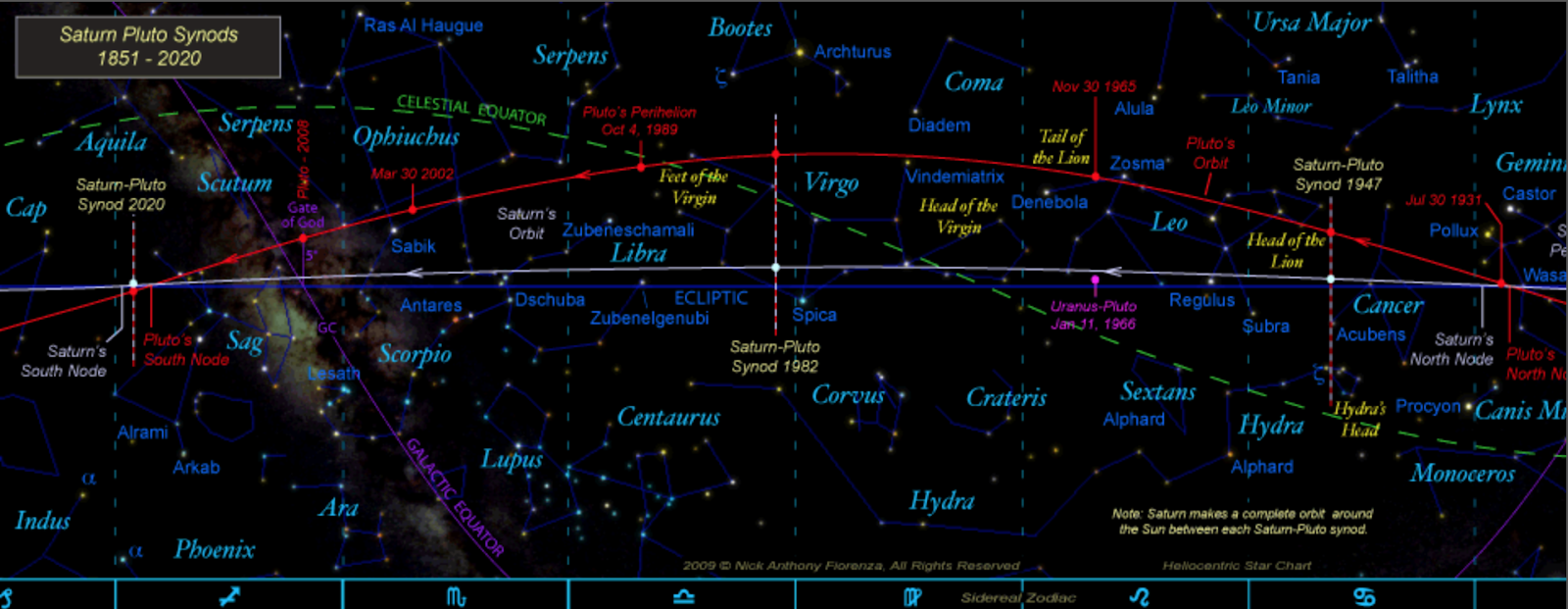
The length of the Saturn - Pluto synodic cycle varies depending on the position of Pluto in its orbit. When it is closer to the Sun, its orbital speed increases and Saturn takes longer to overtake it. Pluto was moving its faster at perihelion in 1990, when it dipped inside the orbit of Neptune. The current synodic cycle which will end in January of 2020 is of about 38 years duration.
FIGURE 1: double click for a closer view. Image address can be found at:
https://www.lunarplanner.com/Saturn-Opp-Uranus/Sa-Pl-History-Images/Saturn-Pluto-synods.gif


A closer look at FIGURE 1 will show how close Saturn and Pluto are during this coming conjunction because their latitudes are almost the same (+0°02' and -0°40' respectively). Compare their proximity to that of their previous conjunction and the difference is quite marked. The author of the chart is using a heliocentric, sidereal zodiac so that's why the zodiacal signs are out of alignment. The reason for my interest in the relationship between these planets is that some sort of economic reset is anticipated in the next year or so and the forthcoming conjunction may be an indicator of its timing. Saturn rules structure, organisation and systems while Pluto oversees transformation.

As near as I can determine, the conjunction will occur at 5:13pm in Basel on January 12th 2020. Why Basel? Well, that's where the Bank of International Settlements (BIS) is located and seeing that it's regarded as the Bank of Banks, then Basel is a reasonable location. It's one hour ahead of Greenwich. The chart is an interesting one and it can be seen immediately that a confluence of synodic cycles is involved because Saturn and Pluto are joined by Mercury, the Sun and Ceres to form a tight and impressive stellium in Capricorn.

The stellium falls almost exactly on the seventh house cusp. The day is a Sunday and one can imagine a special meeting of the financial elite taking place that afternoon and a decision being reached around 5pm about what news to break to the world the next morning. On the previous Thursday, transiting Uranus turned stationary direct in 2°39' of Taurus. The Moon, ruler of the chart and representative of the general public, is in the regal sign of Leo and, fittingly, on the cusp of the second house. A very close quincunx between Uranus and Neptune in the eighth house indicates predictably that the banksters will be guilty of deception and intrigue. Figure 2 shows the chart.

FIGURE 2: chart for the coming conjunction of Saturn and Pluto.
So it seems to me that January 12th 2020 might be a day when big decisions are made concerning the global economy, a new digital currency perhaps for all the nations of the world. Whatever is decided of course, it will be good for the banksters and not so good for the rest of us. The larger implications of the changes may not become apparent or may not be fully implemented until the time when Saturn reaches the square to Pluto. Saturn's subsequent opposition to Pluto should reveal the full extent and consequences of the earlier initiatives.

Friday, 6 April 2018

A Deeper Look at Indonesia's Independence Chart

Here is Indonesia's Independence Chart that I discussed briefly in an earlier post.


Perhaps the most traumatic event in Indonesia's history was the 1965 overthrow of the president, Sukarno. The coup occurred on September 30th and the transits on that day to Indonesia's Independence Chart are shown below:


For me, the outstanding feature is the very close square between transiting Uranus/Pluto and natal Mars/Uranus, consistent with the sudden upheaval and appalling violence. The presence of Uranus and Pluto in the twelfth house reflects the covert nature of the coup, orchestrated behind the scenes by the CIA and other Intelligences Agencies. The Mars/Uranus conjunction is thus a very sensitive spot in the chart and disconnected from any aspect patterns. Its presence in a cadent house and mutable sign adds to its volatility.

Close to the cusp of the eighth house, the point around 1°30' of Taurus is semi-square this conjunction and transiting Uranus will reach this point repeatedly over the next couple of years. Specifically:
  • Mid-June 2018 (moving forward)
  • Late-September 2018 (in retrograde motion)
  • Early April 2019 (moving forward)
  • Mid-January 2020 (when it turns stationary direct in 2°39' of Taurus)
This time frame corresponds to the lead-up and resolution of the 2019 Presidential elections so there is plenty of potential for political unrest.

Thursday, 8 February 2018

Ceres

UPDATE: posted 13th August 2020 (astronomical and not astrological in content) with link

Dwarf planet Ceres is an ocean world with salty water under the surface, NASA mission finds


ORIGINAL ARTICLE:

Having just read a short article on the dwarf planet Ceres, I was motivated to locate its position in my own natal chart and investigate its astrological significance. It's pronounced SAIREEZ by the way, with the accent on the first syllable. I've mispronounced it for most of my life.


This was the article and here is an excerpt:
Dwarf planet Ceres is the largest object in the asteroid belt between Mars and Jupiter and the only dwarf planet located in the inner solar system. It was the first member of the asteroid belt to be discovered when Giuseppe Piazzi spotted it in 1801. And when Dawn arrived in 2015, Ceres became the first dwarf planet to receive a visit from a spacecraft. 
Called an asteroid for many years, Ceres is so much bigger and so different from its rocky neighbours that scientists classified it as a dwarf planet in 2006. Even though Ceres comprises 25 percent of the asteroid belt's total mass, tiny Pluto is still 14 times more massive. 
Ceres is named for the Roman goddess of corn and harvests. The word cereal comes from the same name. 
Ceres was found by an astronomer searching for a star. He thought he found a comet, but with the help of other astronomers decided it was a planet. As more objects were found between Mars and Jupiter, scientists decided Ceres should be called an asteroid—the largest in the region we now call the main asteroid belt. Then, in 2006, Ceres was reclassified as a dwarf planet—the closest one to Earth. 
The largest body in the asteroid belt, Ceres has amassed a number of references in science fiction stories of the 20th and 21st centuries. In the TV series The Expanse, Ceres is inhabited by humans, and in the PC Game Descent, one of the secret levels takes place on Ceres. 
In the video game Destiny, Ceres was colonised by an alien race called the Fallen at the end of humanity's Golden Age. Ceres was later destroyed by a civilisation of post-humans who inhabit the Asteroid Belt. 
In my own chart, Ceres is located in 11d34m of Leo and thus very close to my natal Pluto. Interestingly, transiting Ceres returned to its natal position on January 30th of this year (2018) and is today (8th February 2018) in 9d32m of Leo and thus trine my natal Mars-Venus. It is currently retrograde so, in its current cycle, it first reached its natal position on October 31st 2017 and will reach it again, moving forward, on May 5th 2018. Just prior to this, on May 1st, it will be conjunct the transiting North Node of the Moon in about 10d30m of Leo. So around this time, natal Ceres, transiting Ceres and the transiting North Node of the Moon are pretty much in the same location.

In my natal chart, Ceres in 11d34m of Leo forms a quintile aspect to my natal Moon (separation of 73d06m) and aspects Sun, Venus, Mars and Chiron (by trine), Uranus and Neptune by semisquare (separation of 44d42m), Neptune (by sextile) and of course Pluto (by conjunction). That's an impressive list of aspects. Ceres orbits the Sun every 4.6 years. As for its astrological significance, this site proved most illuminating and the content is worth displaying here in full, with the most salient parts in red:

Astronomical Description

Ceres is the largest of the main belt asteroids and was the first to be discovered on January 1, 1801 by Giuseppe Piazzi, who was making a star catalog at the Observatory of Palermo, which he founded. Shortly after Ceres' discovery, she disappeared behind the Sun, but was "rediscovered" on paper by Carl Friedrich Gauss, who devised a method for calculating an object's orbit from only three accurate positional measurements. She was subsequently relocated on January 1, 1802 by Heinrich Wilhelm Olbers in the position calculated by Gauss. Olbers later discovered the asteroids Pallas and Vesta.  Ceres is part of the main asteroid belt between Mars and Jupiter and orbits the Sun every 4.6 years. Her diameter is 955 kilometres and she is just barely visible to the naked eye, but easily seen with binoculars. 

Mythological Background

Ceres was the Roman goddess who was originally known as Demeter to the ancient Greeks. She was the daughter of Saturn and Rhea and was swallowed by her father along with her sisters Vesta and Juno as well as her brothers, Jupiter, Neptune, and Pluto.  After being freed by Jupiter, these gods and goddesses became the ruling family of ancient Greece. Her gift to humanity was grain and as such was known as the goddess of agriculture and the harvest.  Thus, she was the one who provided nourishment for humanity and was worshipped as such.  She was also the mother of Persephone, a beautiful maiden, with whom she was exceptionally close.  Together, the pair watched over the Earth and allowed it to provide its abundance throughout the year.  This mother and daughter were so enamoured with each other, however, that all suitors were rejected, as the two didn't want to be separated. This, of course, did not go over too well with some of the gods who thought Persephone was pretty damn hot, particularly those nice ankles of hers.

One day Persephone was wandering in the Nysian fields and became fascinated by the hundred-bloomed narcissus.  She picked one of these lovely flowers and was enveloped in its seductive fragrance when the earth opened up beneath her. She was immediately seized by Pluto, god of the Underworld, who had been lusting after her for quite some time, wanting her to become his bride and queen. As soon as he descended below with his prize, the earth resumed its previous state, leaving no sign that anything unusual had occurred.

It didn't take long for Ceres to realise her daughter was missing. For many days she refused to eat, sleep or bathe, but instead wandered about with flaming torches, trying to find her daughter. She eventually encountered the crone goddess, Hecate, who told her to discuss the matter with the Sun god, Helios, who saw everything. Helios told her of the abduction, which had been executed with the approval of Zeus, with whom Pluto had conspired to take Persephone as his bride. Ceres was not only devastated but enraged at the betrayal and, disguised as a mere human, wandered the earth for a while to avoid associating with any of the gods of Mt. Olympus. She acted as a nanny for the son of King Celeus until she eventually revealed her identity and ordered a temple and altar be built for her.

Ceres retired to her temple, where her mourning for Persephone continued. As her grief turned to anger, she cursed the earth such that nothing would grow, neither crop nor fruit of any kind, imposing famine and starvation on mankind. The people prayed to Zeus for relief, who realised that if the humans all died there would be no one left to worship the gods. The gods attempted to reason with Ceres, but she refused to listen or show any mercy unless her daughter was returned to her. Eventually, Zeus relented and sent Hermes to the Underworld to demand Persephone's release. Persephone had likewise been in mourning and fasting, refusing all food and drink. Pluto agreed to let her return, but deviously offered Persephone several pomegranate seeds to quench her great thirst prior to her departure. Not knowing that the pomegranate was the symbol of sexual consummation, Persephone partook, which confirmed her marriage to Pluto. This is a good reason why young women should pay better attention in school, because sometimes it's what you don't know that bites the hardest.

When Persephone returned to the surface, she and her mother had a joyful reunion. However, when Ceres found out that her daughter had consumed the pomegranate seeds, she realised she'd been tricked, since Persephone was still married to Pluto. She reinstated her curse of the earth and the gods were basically back where they started. Eventually, Zeus proposed a compromise, that for each pomegranate seed she'd eaten that Persephone would spend a month in the Underworld as Pluto's bride. The remaining months could be spent on earth with her mother. Thus, each spring Persephone emerges from the Underworld to rejoin her mother. At this time, the earth once more comes alive with vegetation and the harvest is allowed. In the fall, however, when Persephone must return to the Underworld, Ceres once again commands the earth to be barren, until Persephone's return the following spring. Ceres, like so many goddesses, was one vindictive woman and it wasn't a good idea to mess with her.

Astrological Implications

Astrologically, one thing indicated by Ceres' placement in the horoscope will be which area is most important in regard to parental nurturing and the kind of lessons to be derived from the mother-child relationship. For example, if Ceres is in Aries, being allowed and encouraged to be independent will be important as well as being commended for their drive and energy. In Taurus, being comfortable and provided for in a material manner will prevail. Gemini would imply the need for mental stimulation; Cancer, the need for a significant amount of attention and nurturing; Leo, to be the centre of attention; Virgo, for perfection and being of service; Libra, strong relationships and fairness; Scorpio, sexual expression; Sagittarius, a strong belief system and worldly knowledge; Capricorn, ambition and status; Aquarius, friends and being part of a group; Pisces, transcendence and fantasy. It also can indicate the manner in which a person will nurture others in adulthood

The lack of nurturing or encouragement in these areas from one's mother will drive them to seek such elsewhere and if it's blatantly missing or contradicted, it can cause significant emotional trauma and potential identity crises as the person will know there is something missing in their life, but probably won't be able to identify exactly what. The basic tenets of self-esteem are related to early nurturing which, if absent, has repercussions that can take a lifetime to overcome, if ever. Remember that Ceres cuts both ways, as a parent and a child. We also tend to replicate that with which we grew up; patterns established in our childhood tend to reappear with our own offspring in one way or another. Parents also can project their own aspirations or fears onto their children, causing various frustrations for all concerned.

Thus, Ceres tells much about a person's experience and relationship with their mother, particularly if the charts are compared of both mother and child. Transits of Ceres will introduce events represented by the themes in the Ceres/Persephone myth or bring past issues to the surface for resolution. I have yet to see a client who is having "mother issues" who doesn't have something going on involving Ceres in their natal chart transits. Nearly everyone has "mother issues" of some description from their past, and these transits stimulate situations that force us to confront and resolve them.  

As the goddess of agriculture, Ceres can also indicate a "green thumb," love of gardening, or strong interest in food and its preparation. Likewise, if negatively aspected it can be indicative of eating disorders, particularly if food was used during childhood as a punishment by its withdrawal or as a reward. Thus, Ceres can lend astrological clues to a plethora of weight and body-image disorders. On a more positive side, a person's interest in food, from its growth to preparation, can be found in Ceres placement. For example, someone with Ceres in Sagittarius may be inclined to nurture those from other cultures or may have a propensity for preparing international cuisine. 

Ceres also relates to separations and the subsequent sense of loss. It defines grieving style and how a person will deal with their pain. It can also relate to secrets between mother and child; neither person ever entirely knows the other, regardless of how close they may think they are. No matter how much a child loves his or her mother, at some point the need to grow up and seek a mate is likely to arise. This does not mean that they love their mother any less, only the need to progress beyond the role of a child. On the other hand, those that never leave home or are inordinately attached to their mother can also be indicated.  Separations and estrangements from one's mother, no matter what the cause, are also to be found in one's natal chart as well as transits of Ceres throughout the signs, houses, and aspects to the other planets. The more attached we are to someone or something, the more likely we are to be faced with a separation at some point as the energy invested will energise its polarity as well. Frequently, it is only through letting go of something that we allow something new and invigorating to come into our lives.

Sharing of a loved one is another principle in the Ceres myth. In essence, the stereotypical "mother-in-law from hell" could easily be a woman who cannot share her child. Ceres - Pluto aspects often indicate those who will have to share their children with ex-spouses and often undergo ugly custody battles or family kidnapping experiences.  If these individuals don't learn to share, they'll inevitably have to face either the burdens of single parenthood or perhaps be denied access to their offspring entirely. On the other hand, Ceres can impart strong parenting and nurturing capability that allows an individual to assume the role of both parents comfortably.

On the darker side, such things as child abuse and abductions can likewise be reflected in Ceres' placement and hard transits. Of course the ultimate separation is death, as represented by the Underworld. Ceres is often active in death charts, particularly those who die suddenly or in accidents, situations analogous to being kidnapped by Pluto. Death is something that everyone has to deal with, sooner or later. Unlimited grief and mourning at a certain point become self-defeating and hinder your growth. This is another lesson Ceres is wont to convey. 

The richness imparted to a Natal Chart through Ceres is indeed worth consideration, particularly if a person is having difficulty with any issues reflected in the Ceres myth. A trained astrologer can interpret Ceres' placement in the Natal Chart and subsequent transits, yielding clues to the issues at hand. In some cases, for deep-seeded issues, the client will be referred to a trained psychologist to work through those things that go beyond his or her own capability to resolve alone. If Ceres is retrograde in a Natal Chart, as typical of retrograde planets, the energy will be internalised and not expressed as easily, which can complicate any other issues associated with natal aspects or transits.