Astrological Meanderings: Venus
Showing posts with label Venus. Show all posts

Sunday, 6 March 2022

Astrolog Returns

Frustrated with the limitations of Chrome OS Flex on my Mac Book, I installed Ubuntu 20.04 instead. It was then a matter of installing WINE and downloading astrolog.exe. After some tinkering, I was able to get it working although the drop-down menu text is tiny and I can't figure out how to make it larger. Nonetheless it's working but my biggest problem is recovering the astrolog data. I thought I'd backed it up but it appears I hadn't. I'm hoping I can find a backup somewhere. Why didn't I back it up to Google Drive? 

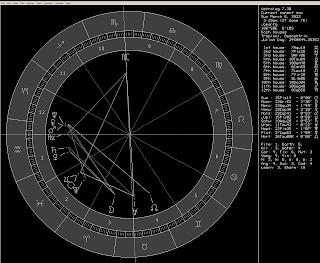
Figure 1 shows the transit picture for 3:29am in Jakarta on March 6th 1953. Venus and Mars are almost exactly conjunct being in 29d38m and 29d41m of Capricorn respectively. The tiny menu bar is visible at the top of the graphic.


Figure 1

If I can't recover my Astrolog data, then I will simply have to rebuild my database that was full of birth details of people that I had long forgotten. There are only a few people whose charts I am really interested in. When I've rebuilt the database, I'll make sure to back it up to Google Drive and also add the information to astrowin.org just to be sure. Figure 2 shows the results of the first entry into the Astrolog database along with the transits.


Figure 2

It's good to have Astrolog back up and running again, because I have total control of what I'm doing. This is not the case with online alternatives where there are more constraints.

Sunday, 27 February 2022

An Absence of Astrolog

After years of running Astrolog under WINE on my Mac laptop, I suddenly find myself without it. The reason is that I installed Chrome OS Flex on the laptop and removed the Macintosh operating system. This OS is still in beta and there are numerous glitches. One of them is an inability to install Linux, after which I could install WINE and then run Astrolog.

On my granddaughter's laptop, I removed the Windows operating system that was capable of running astrolog.exe directly and replace it with Ubuntu. Again, I'm having trouble installing WINE, so the net result is that I can't run Astrolog on either laptop for the moment. I'll have to rely on online programs to keep track of my transits.

However, the Astrolog website links to openastro.org that has an Ubuntu repository that I'm keen to test out. Figure 1 shows a screenshot.


Figure 1

Unfortunately, I get the following error message:

The following packages have unmet dependencies:
openastro.org : Depends :  imagemagick
E: unable to correct problems, you have held broken packages.

Obviously this is something that I need to keep working on. Another promising link that the Astrolog website provides is to Morinus touted as a "Free Astrological Program Written in Python, Using The Swiss Ephemeris". Mind you, the site hasn't been modified since March 18th of 2017. Figure 2 shows a screenshot.


Figure 2

Again, this will take a little more research as I need to install Python from within Chrome OS Flex. Meanwhile, I always have Astrodienst to fall back on. Figure 3 shows a screenshot of my transits for today.


Figure 3

As can be seen, Venus and Mars are rapidly moving toward another conjunction. This upcoming conjunction of the two planets is the third that will occur within a space of about eight months. The dates of these conjunctions are:
  • Tuesday, July 13th 2021
  • Saturday, February 12th 2022
  • Saturday, March 12th 2022
I wrote about the likely effects of these conjunctions in my previous post titled Mars-Venus Conjunction

The site astrowin.org is quite comprehensive and will display transits to a natal chart in two different forms as well as supplying many other features. See Figures 4 and 5.

Figure 4


Figure 5

Monday, 1 November 2021

Moon Out Of Bounds


There is actually a site titled OUT OF BOUNDS ASTROLOGY that discusses the topic of the Moon being "out of bounds", defining it to be when "the declination of the moon in a chart is greater than 23 degrees and 27 minutes north or south". Declination measures the angular distance of an object north or south of the Celestial Equator, the maximum declination of the Sun being ±23°27'. North declination is regarded as positive and south as negative. This is depicted in Figure 1.


Figure 1

The site gives this explanation of Moon out of bounds on the psychology of an individual:
If you or someone you know has a moon out of bounds–found predominantly in the signs of Gemini, Cancer, Sagittarius, and Capricorn–they are likely to exist emotionally in a realm outside of traditional expectations. The emotional outlaw, one with a moon out of bounds tends to make their own rules concerning how to feel about/react to a given stimulus. If living within the bounds of societal constructs, they often tire of dominant trends and experience a pull to escape to a new or remote place. In the city or the country, these are the people who live on society’s fringes in some way or another.
Another site, FORREST ASTROLOGY, notes that:
Earth’s angle of tilt varies over very long scales of time, but it is currently at about 23°28′ according to the Solar Fire Help files. Wikipedia gives 23°26′ ... This maximum limit of 23°28′ declination, south or north, applies rigidly to the Sun. But not to the Moon or the planets. They can go beyond it. Mercury and Mars can reach 27° and Venus can, occasionally, go a degree further. The rest tend to stay within the tropics.

Figure 2 illustrates the situation where the Moon is out of bounds and where it is not.


Figure 2

So interestingly, Mercury, Venus and Mars can also be out of bounds, not just the Moon. The author of the site then goes on to say this about the effects of this lunar phenomenon on an individual:

What does it mean astrologically for the Moon to be Out of Bounds? Start with one merrily anarchic notion: when the Moon’s declination exceeds 23°28′ North or 23°28′ South, it has escaped the physical space dominated by the gravitational “boss” of the solar system, the Sun.

Let the metaphors free-associate.

The Moon is then, in other words, out of the King’s sight. No longer under Daddy’s thumb. We might say that has moved beyond the Pale. Gone out of control. Or gone wild. It has broken the rules. It has shattered the boundaries, broken the mould, crossed the Rubicon. Bravely, or drunkenly, the Moon has said, “Roll the dice.”

The Out of Bounds Moon is spontaneous, emancipated, liberated, released in its own recognisance, and utterly on its own. It has loudly proclaimed, “You can take this job (. . . marriage, church, obligation, moral principle, town, duty . . .) and shove it.” The Moon has claimed its genius, its passion, and its right to be itself. No need to obfuscate, to be diplomatic, or to lie to anyone anymore—unless you feel like it. No more coprophagous grin. No need to worry about staying in anyone’s good graces. Out of Bounds, the Moon no longer plays the game. It rejects all rules that are not of its own making. “Free at last, free at last! Thank God Almighty, we are finally free at last!,” said Martin Luther King, Jr.

The words stir the blood. But we need to let them stir the mind as well.

Structure, discipline, and a world in which our actions have consequences—these are not purely negative things. Society and its values can have a steadying effect upon us, even when we feel frustrated by them. The Out of Bounds Moon, like everything else in astrology, has an unpleasant, dangerous side as well as a divine purpose. Its dark side is sociopathic, even criminal—or merely selfish and insensitive to others. It can be cold, even inhuman.

You may detect some of the underlying spirit of the planet Uranus and the sign Aquarius in these words. That is quite accurate. In my experience, an Out of Bounds Moon has distinctly Aquarian quality. We see the familiar Uranian “holy trinity” at work—the Genius, the Revolutionary and the Criminal. All three of them stand outside the normal structure of society, applying leverage to it—and meeting resistance, condemnation, and consequences for it.

As with Aquarian or Uranian influences, the Out of Bounds Moon often thrusts alienating circumstances upon a person from outside. This is of course the classic working of synchronicity—what we meet (or fail to face) in our inner world is encountered in the “random” realities of our outer lives.

Inwardly, the Out of Bounds Moon often correlates with feelings of being an outsider, of not fitting in, of not having a place in this world. This can be painful—and it can also lead to an attitude of not giving a damn. Or to passivity. Or to resentment. And to radical forms of existential creativity.

The site's author also discusses the frequency with which Moon out of bounds occurs: 
More broadly, there are some years in which many babies are born with Out of Bounds Moons, and some years in which none at all are. This is related to the 18.6 year retrograde cycle of the Moon’s orbital plane—what creates the lunar nodes. (9) We will spare you the details, but here is the bottom line. Every 18.6 years, the Moon reaches its maximum possible declination of 28.5E, a full five degrees outside the tropics. In the years halfway between, we get a kind of “low tide” effect, with the Moon never getting more than 18.5E from the celestial equator. Under those latter conditions the Out of Bounds Moon cannot exist at all. No one born in those years has one.

Thus, over the time-scale of 18.6 years, about half the people born might have an Out of Bounds Moon and about half them could not possibly have one. Furthermore, some of the “good” years for Out of Bounds Moons are more productive than others. That is because times when the Moon goes further Out of Bounds, it stays that way for longer as well. The odds improve.

Even in the “good” years, every couple of weeks the Moon’s monthly orbit brings it back “within bounds” as it passes through the neutral ground between maximum northern and maximum southern declination. It may, in other words, be wildly Out of Bounds in one person’s natal chart—but in the chart of a person born just a week later, the Moon is in 0E declination, as normal as vanilla ice cream. But then a week after that, it is wildly Out of Bounds again.

You really have to calculate it, is the bottom line.

Remembering all our caveats, here are the absolute peak years for Out of Bounds Moon births in living memory: 1913, 1931-32, 1950, 1969, 1987-88, 2006. We will have another one in 2024-25. Remember to give it at least a couple of years on either side. During those years a lot of kids were born with Out of Bounds Moons. But they were mixed in with a large population of more steady, conventional types. Looking at those years, note how the correlations with periods of social unrest and social creativity are rather unmistakable. As ever in astrology, what is “in the air” at given moment lives on for decades longer in holographic form in the children.
The author has a lot more to say on the topic so it's best to go the site and read it all. Another site of interest that I discovered is an Out of Bounds Planet Calculator. Once a date of birth is entered, the determination is made as to what planets were out of bounds at birth but also when progressed planets ceased to be out of bounds and became out of bounds. According to the calculator, it turns out that my Moon was out of bounds at the time of my birth. Here are the details:

Date of Birth: 04/03/49
Natal Out-of-Bounds Planets
Moon     24.59
Progressed Out-of-Bounds Status
Age 5
Moon ceased to be out-of-bounds.
Age 13
Moon became out-of-bounds.
Age 18
Moon ceased to be out-of-bounds.
Age 27
Moon became out-of-bounds.
Age 32
Moon ceased to be out-of-bounds.
Mercury became out-of-bounds.
Age 40
Moon became out-of-bounds.
Age 45
Moon ceased to be out-of-bounds.
Age 51
Mercury ceased to be out-of-bounds.
Age 55
Moon became out-of-bounds.
Age 56
Venus became out-of-bounds.
Age 60
Moon ceased to be out-of-bounds.
Age 68
Moon became out-of-bounds.
Age 72
Moon ceased to be out-of-bounds.
Age 80
Venus ceased to be out-of-bounds.
Age 82
Moon became out-of-bounds.
Age 87
Moon ceased to be out-of-bounds.
Age 95
Moon became out-of-bounds.
Age 98
Mars became out-of-bounds.
Age 100
Moon ceased to be out-of-bounds.

Interesting stuff. However, astro.com provides additional tables for birth charts that show the declinations of natal planets. This reveals that my natal Moon is not out of bounds at all. See Figure 3.


Figure 3

As can be seen, the Moon is listed as being at a declination of 22°54'30'' N. This is close to the limit of 23°27' but not outside it. Only Uranus at 23°37'17"N and Pluto at 24°1'0''N are out of bounds. The problem with the Out of Bounds Planet Calculator can be seen in Figure 4:

Figure 4

As can be seen, there is no input for time or place, only the date. This is not good enough in the case of the Moon because it moves so swiftly. I was born at about 6:56am and I suspect that later in the day, the Moon did move out of bounds. However, when I was born, it was clearly within bounds. Thus all the other data from the Out of Bounds Planet Calculator is to be treated with suspicion.

Astrolog is the program that I use for my astrology calculations and I was curious to see if it would display the declinations of planets. At first sight it doesn't but there is a command line switch -sr0 that instructs the program to display declinations instead of latitudes (the default). The output is shown in Figure 5.


Figure 5

As can seen, the results are the same as those shown in Figure 3, when taken to the nearest minute. Further investigation, using Astrolog, shows that the Moon had a declination of 23°28' N at 10:40am on the day of my birth and only then was it out of bounds.

Once again, Astrolog has shown its capabilities, albeit latent in this case, which is all the more remarkable given that the program was developed in 1994 or possibly earlier.
Tuesday, 13 July 2021

Periodicity of Mars-Venus Conjunctions

I wrote explicitly about Mars-Venus conjunctions in a post titled Mars-Venus on January 27th 2017. However, I've also referred to the topic in Synodic Periods on March 30th 2017 and Mars: A Close Approach and Retrograde Motion of Planets on August 4th 2018. Today (July 13th 2021), when Mars is once again conjunct Venus, I thought it was time to revisit the topic. In this conjunction, the latitudes of these two planets are very close, 1°39' versus 1°11' north latitude. Their longitudes become identical 19°48'57" at 8:33pm, Jakarta time. See Figure 1.


Figure 1

Adapted from Stellarium, Figure 2 shows the view from Jakarta looking to the West about 6:30pm on July 13th 2021. The star Regulus is quite near to the Moon, being at a latitude of 0°08' of Virgo.


Figure 2

This would be the first of three conjunctions of Venus and Mars. The next two conjunctions of Mars and Venus are slated to take place on February 12, 2022 and March 12, 2022. These three form what is called a triple conjunction defined as:
A triple conjunction is an astronomical event where two planets or a planet and a star meet each other three times in a short period, either in opposition or at the time of inferior conjunction, if an inferior planet is involved. The visible movement of the planet or the planets in the sky is therefore normally prograde at the first conjunction, retrograde at the second conjunction and again prograde at the third conjunction. Source.

Figure 3 shows another view of what the first conjunction might look like:


Figure 3

Venus-Mars repeated conjunctions occur every 32 years (plus 0.5 to 4.5 days). During that time, 15 to 17 different conjunctions occur with nearly each one repeating in turn. Some series last >1200 years (up to 40 events). Others are considerably shorter. At the beginning and end of these series, the interval can be one week longer than 32 years. The reason why this happens is because for nearly every 20 times Venus returns to its similar position in the sky, Mars completes almost 15 returns. If these cycles were exactly whole numbers, the repeated conjunctions would last much longer.

This can be confirmed by looking ahead to 2053 and seeing how Mars and Venus are positioned. We find that Mars and Venus are again conjunct in 23°26' of Leo at 7.42pm on July 14th 2053. This is less than 4° from the July 13th 2021 position in 19°49' of Leo. See Figure 4. Remarkable!


Figure 4: Mars-Venus conjunction 2053

Going back to 1989, we find the the two planets were conjunct in 16°17' of Leo at 12:21am on July 13th 1989. This  is about 3.5° behind the 2021 position. See Figure 5.


Figure 5: Mars-Venus conjunction 1989

Wednesday, 17 February 2021

The Great Attractor

In reference to His Tomb, Meher Baba once said:

Seventy years after I drop my body, this place will turn into a place of pilgrimage, where lovers of God, philosophers and celebrities will come to pay homage.

Now Meher Baba dropped His body on January 31st 1969 and seventy years takes us to early 2039. I looked at Baba's chart to note what was happening transit-wise around this time. The most significant aspect to me was the continued crossing and recrossing of His natal Venus by Pluto. This occurs over a time period covering June 2037 to November 2039.


Figure 1

In Figure 1, I've shown that Baba's natal Venus is linked directly (yellow lines) or indirectly (purple lines) to all planets except Uranus (in splendid isolation) and the Chiron/Ceres conjunction. Pluto, representing Rebirth, will act on Venus, The Great Attractor, to draw "lovers of God, philosophers and celebrities" from all over the world and transform Meherabad into a place of worldwide pilgrimage. People will wake up to the reality of Baba, The Great Awakener, and understand His Message.

At the end of 2039, transiting Uranus will be very close to Baba's Descendant and will cross it in early 2040. The progressions for June 2039 show the progressed Moon conjunct natal Venus and progressed Venus/Jupiter conjunct in the fifth house, trine to natal Venus. See Figure 2.


Figure 2

As of 2021, there is a growing but still very limited awareness of Meher Baba within the global population. Baba's prophecy would suggest that there must some dramatic changes in the world over the next eighteen years in order for His name to become more widely known. At the moment, scientism is the new religion and looks set to dominate the 21st century. However, if faith in scientism wanes for whatever reason, people will be looking for something to replace it. For some a return to the religions of the past will be an option but for the majority this will not satisfy. Baba's teachings are ideal for a disillusioned humanity who is seeking spiritual sustenance free of religious dogma. In His own way, Baba will bring about this spiritual awakening.

Thursday, 30 January 2020

Patricia Highsmith

I recently finished Joan Schenkar's biography of the novelist Patricia Highsmith. It was a very interesting read. Figure 1 shows the cover of that book. I've seen four movies that I know of, based on her books. The first is Alfred Hitchcock's 1951 "Strangers on a Train" that I saw many decades ago and just now watched again because I'd forgotten the details completely. The second is "The Talented Mr Ripley", the third is "Carol" based on her novel "The Price of Salt" and the fourth is "The Two Faces of January". Sadly, I've not read any of her books as yet but may get around to doing so
.
Figure 1: front cover of biography
Some details that emerge from the biography are:
  • she was predominantly a lesbian although she did have some affairs with men
  • she started off writing captions for comics in the 1940's
  • her novels usually involve murder and duality e.g. Tom Ripley impersonating Dickie
  • she had an intense love-hate relationship with her mother
  • she had little contact with her biological father and never liked her step-father
  • she enjoyed sketching, gardening and working with wood (making tables, chairs etc.)
  • her sexual relationships with women were very stormy
  • she travelled relentlessly, especially in her earlier years
  • she was more comfortable living in Europe and was far better known there
  • all of her novels were translated into French, German and other European languages
  • many of her novels were made into movies, either in Hollywood or Europe
  • she drank prodigiously throughout her life (and smoked as well)
  • she ate very little
  • she was parsimonious, although sometimes uncharacteristically generous

Figure 2 shows her chart and I'll try to relate it to some of the dot points I've made earlier.

Figure 2: https://www.astrotheme.com/astrology/Patricia_Highsmith

Patricia's sexual ambiguity (she felt from an early age that she was a boy) is attributable to Mars conjunct Venus in the fourth house in Pisces. The fourth house represents ones psychological foundations suggesting the male and female principles struggling for supremacy and the boundaries between the two eroded by the amorphous nature of Pisces. She was always at war with herself or her mother, onto whom she tended to project her this inner conflict. She perceived less as a mother figure and more as a rival. She was largely raised by her grandmother for the first six years of her life and she got on well with her (Moon trine Sun).

The struggle between Mars and Venus in her psyche is echoed in the conjunction between Jupiter (her ruling planet) and Saturn in her tenth house, in Virgo. Once again there are two diametrically opposite tendencies in close proximity to each other. This constant tension in herself, that she usually projected into her relationships, was fuel for her novels and whenever she was going through a period of relative equanimity in herself and in her relationships, her productivity would suffer. The pairing of Mercury (ruler of her tenth house) and the Sun on the cusp of the third house is consistent with her career as a novelist.

Her penchant for homicide as a plot element in her novels can be attributed to the close trine between Mars and Pluto (in the eighth house) or the almost exact trine between Pluto and the mid-point of Mars and Uranus. Murder was always on her mind, with sex and death closely interlinked.

Her fondness for gardening and her lifelong interest in woodworking can be attributed to her grand trine in Earth signs, the Sun is in Capricorn, the Moon in Taurus, and Saturn is in Virgo. The Moon in Taurus accounts for the importance she attached to her base or bases of operation. Even though she moved continually between the United States, England and Europe (Sagittarius is rising let's not forget), the houses in which she lived were very important to her.

There is an almost exact quincunx between Neptune and the mid-point of Mars and Venus. Patricia's copious consumption of alcohol was a constant throughout her life and doubtless this aspect contributed to her dependency.

That's enough for now. I'll probably return to this later and add more comments. Here are some snaps of the movies that were made from her books: Figures 3, 4, 5 and 6.

Figure 3: A thriller centred on a con artist, his wife,
and a stranger who flee Athens after one of them is
caught up in the death of a private detective.


Figure 4: A psychopath forces a tennis star to comply with
his theory that two strangers can get away with murder.


Figure 5: In late 1950s New York, Tom Ripley, a young underachiever,
is sent to Italy to retrieve Dickie Greenleaf, a rich and spoiled millionaire playboy.
But when the errand fails, Ripley takes extreme measures.


Figure 6: An aspiring photographer develops an intimate
relationship with an older woman in 1950s New York.

Tuesday, 11 June 2019

Minutiae

The British pronunciation of minutiae is muh·nyoo·shai whereas the American is mi·noo·shee·uh but in any case the meaning is the same, namely the small, precise, or trivial details of something e.g. "the minutiae of everyday life". In this post, I'm going to consider the minutiae of aspects cast by transiting planets to a natal chart, specifically my own natal chart.

Normally I only consider the transits of the slow moving astrological bodies like Jupiter, Saturn, Chiron, Uranus, Neptune and Pluto. Sometimes I consider Mars but rarely do I look at the position of Mercury. However, today I had an accident. It wasn't serious but I did stumble at the foot of some steps and sustained some bruising to my knee and ankle.

It was only later that I thought to consider what transits might have been active at the time of my fall which occurred around 5:45pm in Jakarta. Figure 1 is what the transits looked like at the time of my fall.
Figure 1

As it turns out, there was a very appropriate aspect. Transiting Mercury in 11°22' of Cancer in my third house was square to my natal Mars - Venus in 9°16' - 9°10' of Aries and my Sun in 12°47' of Aries. In fact the mid-point of my Mars - Venus and Sun in 11°00' of Aries. 

So little more needs to said but it made me aware of the usefulness of taking note of small incidents instead of always waiting around for big developments involving the slower moving planets. Mercury yesterday at 5:45pm was in 9°46' of Cancer and tomorrow it will be in 12°55' of Cancer, so it moves fairly swiftly.

Thursday, 30 March 2017

Synodic Periods

A friend of mine had noticed that significant events or changes in a person's life occurred at 47 years of age. I decided to see what Wikipedia had to say about the number 47 and was surprised to discover the following:
The 47-year cycle of Mars: after 47 years (22 synodic periods of 780 days each), Mars returns to the same position among the stars and is in the same relationship to the Earth and Sun. The ancient Mesopotamians discovered this cycle.
The synodic period is defined as "the amount of time that it takes for an object to reappear at the same point in relation to two or more other objects ... the time between two successive oppositions or conjunctions is also an example of the synodic period." Source. In the case of Mars, the 47-year cycle relates to the positions of Mars and the Sun. After 47 years years, the Sun and Mars should return to their original positions. My calculations showed that the exact figure is 46.97856377 years which seems close but is actually almost eight days less than 47 years. Further calculations revealed that there is a much closer alignment after 79 years or 79.00940271 to be more exact. This turns out to be about 3.43 days past the 79 years.

It's a fairly easy matter to set up the calculations in a worksheet. The formula is:


where SP1 and SP2 are the sidereal periods of the two bodies of interest. The sidereal period by the way is "the amount of time that it takes an object to make a full orbit, relative to the stars." The table below, copied from my worksheet, shows the sidereal and synodic periods for the various planets.


The multiples of these synodic periods when divided by 365.24217 give the number of years that have elapsed. When the number is very close to an integer, it means that the configuration between the two planets at time zero recurs near the same point in the zodiac. For example, such a conjunction between Venus and Mars recurs after 31.99799406 years which is very close to 32 years (about 0.73 days less to be precise). The synodic period of Venus and Mars is less than a year (333.9 days) and for someone like myself, with the two planets conjunct, it is important but because of its frequency there is a tendency to undervalue its significance. The synodic cycle becomes more meaningful when viewed as part of a larger, "super-synodic" cycle in which the two planets return to the same relationship but in close proximity to their original zodiacal positions.

For Venus and Mars, this larger super-synodic cycle involves 35 synodic cycles and, because the prime factors of 35 are 5 and 7, the 5th, 7th, 10th, 14th and so on cycles become particularly important. They resonate with the larger cycle while the others (2nd, 3rd, 4th, 6th, 8th and so on) do not. Other patterns emerge: the 14th/15th and 20th/21st cycles form twin resonating pairs and occur after 12.79919762/13.71342603 years and 18.28456803/19.19879644 years. The next pairing is the 49th/50th and 55th/56th occurring after 44.79719168/45.71142009 years and 50.28256209/51.1967905 years. In the life of an individual with Venus and Mars conjunct in the natal chart, the periods around the 44th/45th and 50th/51st birthdays should be significant, especially in terms of relationships. I can assure you that they were.

These resonating cycles can be applied of course to all super-synodic cycles. For example, the 47 year synodic cycle of the Sun and Mars occurs after 22 cycles. The factors of 22 are 2 and 11 so every even numbered cycle is resonant but so is the 11th. This means that the 10th, 11th and 12th cycles are all resonant and thus the energy of the Sun-Mars relationship will find emphatic release during the period from 21.35389262 through 23.48928189 to 25.62467115 years. This is illustrated in the diagram below:


For someone like myself with Sun conjunct Mars, this period from my 21st to 25th birthdays was a very energetic time. It is of course for most young people but during this time I was indeed very focused, completing a university degree that I had started years earlier but never finished. After this period, I rapidly lost focus again and never quite summoned up that same level of motivation and concentration ever again. The second time around the 32nd, 33rd and 34th cycles are all resonant corresponding to 68.3324564 through 70.46784566 to 72.60323492 years. Now that I'm approaching my 68th birthday, I'm hoping for a similar infusion of energy. I can only hope my old bones are up to it.

Of course with the outer planets of Jupiter, Saturn, Uranus, Neptune and Pluto, the synodic periods are less frequent. Jupiter and Saturn have a famous synodic period of a little under 20 years that has been linked to the deaths in office of United States president taking up office in 1960, 1940, 1920 etc. This pattern of deaths is known as the Curse of Tippecanoe or Tecumseh's Curse (source). While it is not likely that two outer planets will return to their natal positions during the life of an individual, their return would be important in mundane astrology.

Friday, 27 January 2017

Mars-Venus

Given that I have Mars-Venus conjunct in my natal chart, I'm always interested in the relative positions of the two planets. At the moment of writing (morning of 27th January 2017), the two planets can be seen close together in the evening sky. Mars is quite faint in comparison to Venus because it over three times further away and has a markedly lower albedo anyway. Here is a depiction of the situation using a screenshot from Stellarium, with annotations added afterwards.


Mars is now in the last degree of Pisces and about to enter Aries. The picture shows the proximity of Mars to the Vernal Equinox, where the Ecliptic and Celestial Equator intersect. As described in my previous post, with screencast added, the two planets will move in tandem through Aries over the next couple of months but will remain a few degrees apart until Venus turns retrograde whereupon the zodiacal distance between the two will increase rapidly.

While Mars is faint at the moment, it isn't always like that. Less than 14 years ago, things were very different as the following paragraph describes:


Figure 1
Mars was closest on August 27, 2003. On Aug. 28, Mars arrived to its "opposition." This is the moment when the Sun, Earth and Mars are in alignment (see Figure 1). Mars grows larger and brighter every time a Mars opposition occurs, about every 26 months (780 Earth days), but this specific event is unique for two additional reasons. The orbits of Mars and Earth are elliptical rather than exact circles—that of Mars even more so than Earth's. At the time of the alignment, Mars was at its closest point to the sun in its orbit (called a Mars perihelion). This phenomena (a Mars perihelic opposition) occurs about every 15 to 17 years. In addition, Earth is quite close to its furthest point from the Sun (call an aphelion), which actually occurs a bit earlier in the year. Thus, Earth is pushing outward toward Mars while Mars is reaching inward toward Earth. This rare coincidence of events brought Earth and Mars extraordinarily close (about 55.8 million kilometres).
That record close distance of 55.8 million kilometres is far closer than Venus is now, at 86 million kilometres. As for the time between the zodiacal conjunctions of Mars and Venus (the synodic period), this can be calculated using the formula: 1/(SPM-SPV) where SPM is the sidereal period of Mars and SPis the sidereal period of Venus (687 days and 225 days respectively). The result is slightly less than 334 days. However, this is clearly just an average because the actual time between conjunctions can be wildly different.

To illustrate, let's go back to August 29, 2015 when Venus and Mars were conjunct. A relatively short time later, on November 3, 2015, they were conjunct again but they not meet at all in 2016. While the two planets are moving closer together at the current time, they are not conjunct until October 5, 2017. This is a gap of almost two years. However, the gap of 768 days between the first conjunction and the third is 768 days, giving an average of 384 days. There is another conjunction on August 24th 2019. The time between this fourth conjunction and the first is 1456 days, giving an average of 364 days. So the trend seems to be toward the figure of 334 days.


on July 13th 2021, the date of a Mars-Venus conjunction

Wednesday, 18 January 2017

Using Screencastify with Astrolog


I thought I'd experiment with using Screencastify to record actions in Astrolog with accompanying voice commentary. The resulting video looks good when opened in a web browser but uploading to Blogger using the video upload button produced a dreadful result. It seemed to make use of the Adobe Flash plugin which is weird because the webm format that Screencastify uses is meant to work in HTML5 without any plugins. The resulting video was small, dark and using the expand option zoomed the video to what seemed like 200% or more with most of the screen lost.

Fortunately, YouTube rendered the video beautifully and provided the embed code that I've used here. I'm very happy with the result. Technology aside, the purpose of the video was to show the movement of Venus and Mars through Pisces and Aries over the coming couple of months. The planetary positions are shown from January 17th until March 4th when Venus turns retrograde in Aries, almost exactly conjunct my native Sun. At the same time, Mars has just passed my Ascendent. Uranus remains active during the whole time of course.