Astrological Meanderings: synodic period
Showing posts with label synodic period. Show all posts

Tuesday, 14 March 2023

More About Pluto in Aquarius

A year ago, in a post titled Pluto in Aquarius, I wrote the following in reference to Pluto's entry into Aquarius on March 24th 2023:

Pluto will remain in Aquarius only until June 11th 2023. It's return to Capricorn may mark a lull in the pace of change but when Pluto returns to Aquarius on January 21st 2024, to begin its twenty-year passage through the sign, the pace of change will accelerate and the technocratic dream will move closer and closer to reality.

This is not entirely accurate because, even though Pluto does reenter Aquarius on the date stated, it retrogrades to Capricorn yet again from September 1st 2024 until November 19th 2024. Once it reenters Aquarius, it will remain in that sign until 2043.


Dates may be a day off due to time zones

I also make the following observation in that post about Saturn's entry into Pisces on March 8th 2023:
... when Pluto enters Aquarius in March of 2023, Saturn has already entered Pisces. It will remain in Pisces until it enters Aries on May 25th 2025.  That two year period should mark a dissolution of many of the old systems and structures of the past as Pluto wipes the slate clean so that humanity can enter a technocratic utopia or dystopia, depending on your point of view.

In a later post in October of 2022 titled More About Pluto's Peregrinations, I wrote:

Getting back to Pluto's astrological significance, the great conjunction of mid-January 2020 that kicked the whole scamdemic nightmare involved the Sun, Ceres, Mercury, Saturn and Pluto. Clearly Saturn and Pluto are the long term players here and remarkably, given the divergence of the latter from the plane of the ecliptic, the latitudes were almost the same (+0°02' and -0°40' respectively) at the time of conjunction. The synodic cycle of the two planets is about 38 years and so the semi-square and square will be significant as well as the entry of Pluto into Aquarius.

Should we consider the semi-square of Saturn to the original conjunction point or should we consider the relative positions between the transiting Saturn and transiting Pluto. Probably both are significant. On June 17th of 2023, Saturn will turn stationary retrograde in 7°12' of Pisces with 7°50' of Pisces being the exact semi-square between Saturn and its original position. Pluto will enter Aquarius on March 24th of 2023 for a few short months before returning to Capricorn on June 12th 2023 ... Looking ahead I'd say that the period from March 2023 until June 2023 will be quite active as the global mafia attempts to push forward with its agenda.

Saturn will enter Pisces on March 8th 2023 which only adds more weight to the importance of the March to June period.

So far as March goes, we do seem to be getting a sneek preview of the transformations to come as some banks in the USA are collapsing and needing to be bailed out by the Fed. The movements of Pluto certainly give some idea of the rhythm of the transformation with deliberate overlap of months to show the gradual transitions.

  • March 2023 to June 2023: a sneek preview of the new system with the frailties of the old system on full display. Pluto in Aquarius.

  • June 2023 to January 2024: the old system struggles on but is clearly on life support. Pluto in Capricorn.

  • January 2024 to September 2024: the new system reveals itself more fully and the inevitable death of the old system becomes more apparent. Pluto in Aquarius.

  • September 2024 to November 2024: some changes are put on hold as a brief respite is called before the new system is rolled out. Pluto in Capricorn.

  • November 2024 onwards: it's full steam ahead now as the old structures have been fully dismantled and the new system is embraced but perhaps "thrust upon us" is a more accurate description. Pluto in Aquarius.
The new system will inevitably involve CBDCs and most people will be grateful. Months of bank collapses, lost pension funds and financial chaos will dispose people to accept the promise of a solution in the form of a CBDC. The full implications of the system will not become apparent until the programmable nature of this digital money becomes apparent. Governments will begin to apply restrictions on how the money can be spent. Fines can be imposed instantly and it will up to the individual to challenge them and try to recover the money. Accounts can be frozen without notice or justification. The more dictatorial the government, the more extreme the restrictions but all governments will exercise this power to a greater or less degree.

Wednesday, 13 May 2020

Backwards and Forwards


Figure 1

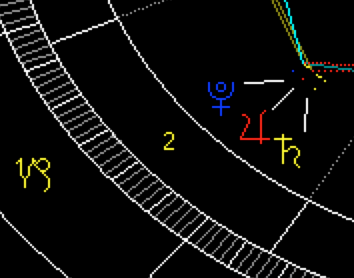
Today is May 12th 2020. On May 14th, Jupiter will become retrograde. Saturn became retrograde on May 11th and Pluto on April 25th. All three will continue their retrograde motion until:

  • Jupiter turns direct on September 12th 2020
  • Saturn turns direct on September 29th 2020
  • Pluto turns direct on October 4th 2020
See Figure 1 for details:


The conjunction of January 12th 2020 involved Mercury, Sun, Ceres, Saturn and Pluto with Jupiter not involved (see my post: In the Time of Corona) at that time but entering upon the scene a little later. My speculation is that the retrograde motion of Jupiter, Saturn and Pluto in the area of the original conjunction point will mark a loosening of the medical martial law that has been imposed on the population of the planet. The powers-that-ought-not-to-be will analyse the success of their plandemic and prepare for a second wave that will be unleashed in early October of 2020 (as all three planets turn direct).


The orbital period of Ceres, closely associated with harvests and food, is about 4.6 years and so the squares and opposition to the conjunction point in 22° of Capricorn may mark periods of food crises. Ceres almost returns to its original position when it turns stationary retrograde in 21°27' of Capricorn on May 14th 2024 (almost exactly four years from now). 

The synodic period of Saturn and Pluto is between 33 and 37 years and of course Saturn will be casting different aspects to the Saturn-Pluto conjunction point throughout its 29 year cycle of the zodiac. The full impact of what is happening now may only be fully realised about 15 years in the future when Saturn reaches the opposition to the conjunction point. 

Anyway, getting back to October 4th 2020, we note that on that day:
  • Pluto is in 22°29' of Capricorn and thus almost exactly where it was on January 12th 2020
  • Saturn is in 25°22' of Capricorn
  • Jupiter is in 18°09' of Capricorn
The midpoint of Jupiter-Pluto is thus around 21°45' of Capricorn and so very close to Pluto's position. It makes for an impressive sight when compared to the original positions (see Figure 2):

Figure 2

Saturn is very close to the Basel Descendant and for this reasons the restrictions may be more draconian than those applied in the first wave. 

Who knows what may happen? 

Certainly possible are forced vaccinations and removal of persons from their home environment if they are suspected of being infected. 

The tyranny of our psychopathic rulers knows no limits.

Tuesday, 4 June 2019

Financial Reset

I made the following post and then realised that I'd earlier made a post titled Saturn and Pluto Synodic Cycle  late last year. No matter. In the earlier post I'd focused on Basel whereas in this post I've considered London instead. While there is some overlap, the latest post has some alternative and additional information. It also indicates that the conjunction has been on my mind for some time now.

It seems that the role assigned Donald Trump by his Zionist overlords is to destabilise the world's economic system via trade wars and military tensions. The world economy of course has been in parlous shape since 2008 and it's surprising that the wheels haven't fallen off before now. There must be a major financial reset in the very near future and what better time to trigger it than amidst economic chaos and threats of war.

Israel has never had a US president so compliant to its every demand and it will make full use of him for the remainder of his term in office. With US presidential elections at the end of 2020, a meltdown of the global economy should be expected before then along with a new economic order. The conjunction of Saturn and Pluto in Capricorn in mid-January of 2020 is the strongest indicator that I can see for such a development.

I've drawn up a chart for London as the day dawns on Monday, January 13th 2020. The conjunction falls on the Sunday but global markets won't be open then and trading will begin in London later that morning. I've chosen London because historically it was the centre of the world economy and it still plays a very important role. Figure 1 shows a dramatic chart with Mercury, Sun, Saturn and Pluto all conjunct on the rising degree.

Figure 1: dawn in London on January 13th 2020

Interestingly in late November of 2020, Jupiter, Saturn and Pluto will be closely aligned in Capricorn. The involvement of Jupiter suggests some sort of new direction following the destruction by Pluto of the old economic order, represented by Saturn in Capricorn. However, getting back to the actual conjunction, it should be noted that the latitudes of the two planets are also very close, Saturn being 0°40’ S and Pluto being 0°02’ N. That's a separation of only 0°42'. This should add potency to the conjunction. This can be seen clearly in Figure 2 (taken from this site) in which the proximity of the two planets in terms of both celestial latitude and longitude can be clearly seen. Pluto can move quite some distance north and south of the celestial equator

Figure 2

It's interesting to look back of the last conjunction of these two planets. Figure 2 shows an excerpt from an article about these conjunctions:


There is quite a detailed historic examination of Saturn-Pluto interactions at this site titled:

Synodic Astrology
The Saturn-Pluto Synodic Cycles
A Historical Exploration
1851 - 2020

This is an exploration of the historical events occurring in the previous Saturn-Pluto Synodic Cycles and during the primary phase transitions occurring within those cycles, including the Saturn-Pluto square of 2009-2010.

Tuesday, 13 November 2018

Saturn and Pluto Synodic Cycle

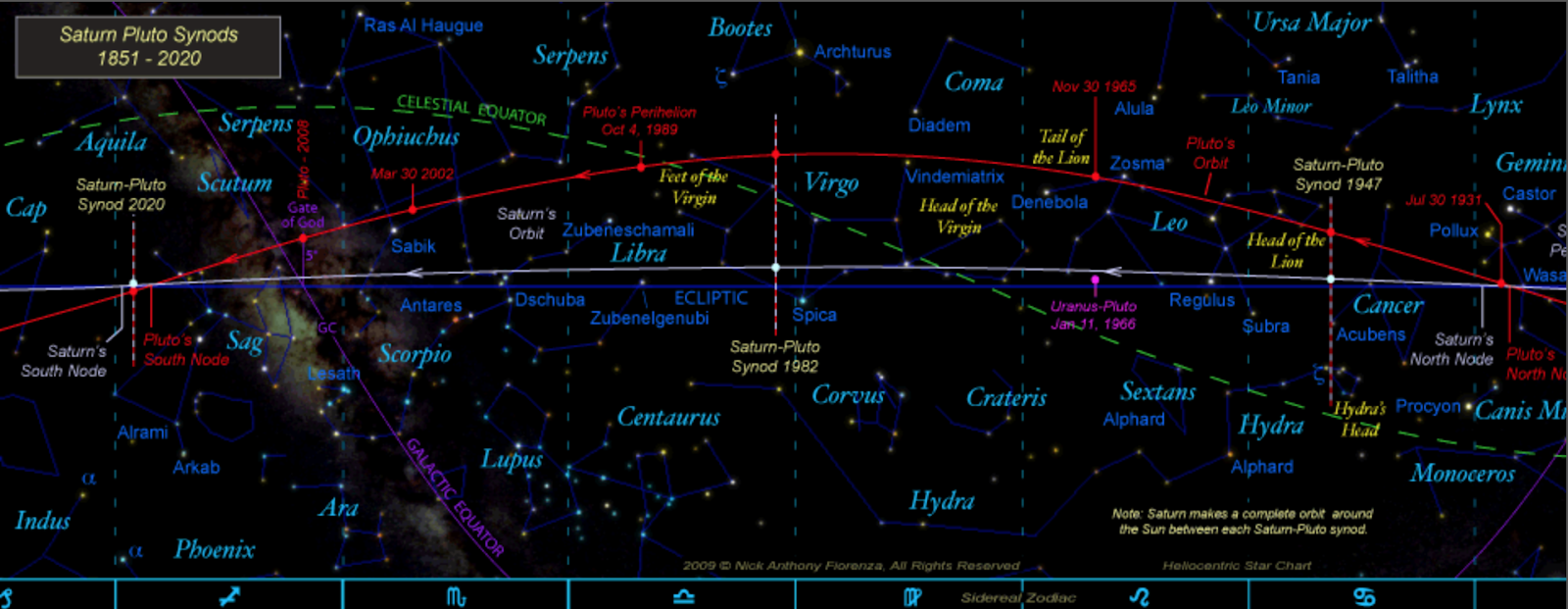
The length of the Saturn - Pluto synodic cycle varies depending on the position of Pluto in its orbit. When it is closer to the Sun, its orbital speed increases and Saturn takes longer to overtake it. Pluto was moving its faster at perihelion in 1990, when it dipped inside the orbit of Neptune. The current synodic cycle which will end in January of 2020 is of about 38 years duration.
FIGURE 1: double click for a closer view. Image address can be found at:
https://www.lunarplanner.com/Saturn-Opp-Uranus/Sa-Pl-History-Images/Saturn-Pluto-synods.gif


A closer look at FIGURE 1 will show how close Saturn and Pluto are during this coming conjunction because their latitudes are almost the same (+0°02' and -0°40' respectively). Compare their proximity to that of their previous conjunction and the difference is quite marked. The author of the chart is using a heliocentric, sidereal zodiac so that's why the zodiacal signs are out of alignment. The reason for my interest in the relationship between these planets is that some sort of economic reset is anticipated in the next year or so and the forthcoming conjunction may be an indicator of its timing. Saturn rules structure, organisation and systems while Pluto oversees transformation.

As near as I can determine, the conjunction will occur at 5:13pm in Basel on January 12th 2020. Why Basel? Well, that's where the Bank of International Settlements (BIS) is located and seeing that it's regarded as the Bank of Banks, then Basel is a reasonable location. It's one hour ahead of Greenwich. The chart is an interesting one and it can be seen immediately that a confluence of synodic cycles is involved because Saturn and Pluto are joined by Mercury, the Sun and Ceres to form a tight and impressive stellium in Capricorn.

The stellium falls almost exactly on the seventh house cusp. The day is a Sunday and one can imagine a special meeting of the financial elite taking place that afternoon and a decision being reached around 5pm about what news to break to the world the next morning. On the previous Thursday, transiting Uranus turned stationary direct in 2°39' of Taurus. The Moon, ruler of the chart and representative of the general public, is in the regal sign of Leo and, fittingly, on the cusp of the second house. A very close quincunx between Uranus and Neptune in the eighth house indicates predictably that the banksters will be guilty of deception and intrigue. Figure 2 shows the chart.

FIGURE 2: chart for the coming conjunction of Saturn and Pluto.
So it seems to me that January 12th 2020 might be a day when big decisions are made concerning the global economy, a new digital currency perhaps for all the nations of the world. Whatever is decided of course, it will be good for the banksters and not so good for the rest of us. The larger implications of the changes may not become apparent or may not be fully implemented until the time when Saturn reaches the square to Pluto. Saturn's subsequent opposition to Pluto should reveal the full extent and consequences of the earlier initiatives.

Saturday, 4 August 2018

Mars: A Close Approach and Retrograde Motion of Planets

Figure 1
In 2018, Mars will appear brightest from July 27 to July 30. Its closest approach to Earth is July 31. That is the point in Mars' orbit when it comes closest to Earth. Mars will be at a distance of 57.6 million kilometres ... In 2003, Mars made its closest approach to Earth in nearly 60,000 years! It won't be that close again until the year 2287. Source.
Of course, Astrology doesn't take these close encounters of Mars or any other planet into account at all. The astrological chart is only concerned with a planet's celestial longitude or the angular distance of a planet east of the vernal equinox, measured along the ecliptic. Thus on July 31st at 4:33pm in Brisbane, Mars was in 3°02' of Aquarius or 303°02' east of the vernal equinox. It's celestial latitude was 6°33' South but this is not considered in chart analysis as far as I know.

Should the proximity of Mars to Earth be considered in chart analysis? Will Mars be more influential in the charts of persons who were born on July 31st 2018 compared with charts where Mars is at a maximum distance from Earth? Is a transit of Mars more powerful when it is closer to Earth than when it is farther away? I really don't know. However, what is known is that Mars is opposition to the Sun during such encounters and there is always period of time in which Mars appears to move backward through the zodiac because Earth is "overtaking" Mars because of the latter's slower orbital velocity. Mars is retrograde in Aquarius and Capricorn from June 26th to August 27th, 2018. Figure 2 shows this.

Figure 2 
In general, Mars is retrograde approximately 58-81 days every 2+ years. Cafe Astrology. com makes the following observation about a retrograde Mars in the natal chart:
If Mars is retrograde in the natal chart, this is what the Karmic Insight report has to say about this position: “Asserting yourself vigorously and directly is complicated by the fact that you had a prior lifetime or lifetimes in which aggression was either misused (by you, or against you) and/or all personal initiative and self-will was insistently discouraged (perhaps due to a belief system that advocated passivity). 
In any case, the message that was impressed upon you was that forceful action is wrong or dangerous. Thus, if you stand up for yourself, you now tend to hesitate, back down or even be plagued with fears of retaliation.”
Most natal charts will thus not have Mars retrograde. In 90% or more of natal charts, Mars will be in direct motion. This got me thinking about the periods of retrograde motion of other planets. Cafe Astrology. com has a lot to say about Mercury retrograde, a phenomenon that occurs approximately three times a year for approximately three weeks each time. Here is a quick quote:
When Mercury is retrograde in the natal chart itself, the thinking processes are generally more acute, and the sense of humour rather quirky. People with Mercury retrograde take in information differently than those with Mercury direct in their natal charts. How many people are born with a retrograde Mercury? Roughly 18%. 
Venus appears to retrograde approximately 40-43 days out of every 18 months or around 7-8% of its orbit.  How does a retrograde Venus affect a natal chart? Again Cafe Astrology. com has a lot to say about this. Here is an excerpt:
When Venus is retrograde in the natal chart itself, the feeling nature is deep. Socialising is taken seriously, and rarely lightly. They can be somewhat shy in youth, as there can be an awkwardness felt concerning small talk and social graces, and an aversion for superficialities. Love is extremely important to a person with a retrograde Venus, but they may not be explicit about it enough for others to know just how deeply they can love. There is always more to this person than meets the eye. Their love life (and sometimes financial life) can be hidden in some manner.
Cafe Astrology.com has a page about retrograde motion in general in which the point is made that as we move further out with the planets, retrogrades occur more frequently, and it is more common for people to have these planets retrograde in their charts. There follows descriptions for Jupiter, Saturn, Uranus, Neptune and Pluto in retrograde motion, although no percentages for the amount of time spent retrograde. However, I discovered the following summary on Quora:

Planet --> Synodic period, days --> Synodic period, mean months --> Days in retrograde -->  %

Mercury --> 116 --> 3.8 -->   ~21 -->   18
Venus --> 584 --> 19.2 -->    41  -->     7
Mars --> 780 --> 25.6 -->     72 -->      9
Jupiter --> 399 --> 13.1 -->  121  -->    30
Saturn --> 378 --> 12.4 -->   138  -->    37
Uranus --> 370 --> 12.15 -->   151 -->    41
Neptune --> 367 --> 12.07 -->   158  -->    43

Pluto of course would be even closer to 50%. The table clearly shows that persons with Mercury, Venus and Mars retrograde are in a distinct minority and that it should be a factor to consider when interpreting natal charts.

Thursday, 30 March 2017

Synodic Periods

A friend of mine had noticed that significant events or changes in a person's life occurred at 47 years of age. I decided to see what Wikipedia had to say about the number 47 and was surprised to discover the following:
The 47-year cycle of Mars: after 47 years (22 synodic periods of 780 days each), Mars returns to the same position among the stars and is in the same relationship to the Earth and Sun. The ancient Mesopotamians discovered this cycle.
The synodic period is defined as "the amount of time that it takes for an object to reappear at the same point in relation to two or more other objects ... the time between two successive oppositions or conjunctions is also an example of the synodic period." Source. In the case of Mars, the 47-year cycle relates to the positions of Mars and the Sun. After 47 years years, the Sun and Mars should return to their original positions. My calculations showed that the exact figure is 46.97856377 years which seems close but is actually almost eight days less than 47 years. Further calculations revealed that there is a much closer alignment after 79 years or 79.00940271 to be more exact. This turns out to be about 3.43 days past the 79 years.

It's a fairly easy matter to set up the calculations in a worksheet. The formula is:


where SP1 and SP2 are the sidereal periods of the two bodies of interest. The sidereal period by the way is "the amount of time that it takes an object to make a full orbit, relative to the stars." The table below, copied from my worksheet, shows the sidereal and synodic periods for the various planets.


The multiples of these synodic periods when divided by 365.24217 give the number of years that have elapsed. When the number is very close to an integer, it means that the configuration between the two planets at time zero recurs near the same point in the zodiac. For example, such a conjunction between Venus and Mars recurs after 31.99799406 years which is very close to 32 years (about 0.73 days less to be precise). The synodic period of Venus and Mars is less than a year (333.9 days) and for someone like myself, with the two planets conjunct, it is important but because of its frequency there is a tendency to undervalue its significance. The synodic cycle becomes more meaningful when viewed as part of a larger, "super-synodic" cycle in which the two planets return to the same relationship but in close proximity to their original zodiacal positions.

For Venus and Mars, this larger super-synodic cycle involves 35 synodic cycles and, because the prime factors of 35 are 5 and 7, the 5th, 7th, 10th, 14th and so on cycles become particularly important. They resonate with the larger cycle while the others (2nd, 3rd, 4th, 6th, 8th and so on) do not. Other patterns emerge: the 14th/15th and 20th/21st cycles form twin resonating pairs and occur after 12.79919762/13.71342603 years and 18.28456803/19.19879644 years. The next pairing is the 49th/50th and 55th/56th occurring after 44.79719168/45.71142009 years and 50.28256209/51.1967905 years. In the life of an individual with Venus and Mars conjunct in the natal chart, the periods around the 44th/45th and 50th/51st birthdays should be significant, especially in terms of relationships. I can assure you that they were.

These resonating cycles can be applied of course to all super-synodic cycles. For example, the 47 year synodic cycle of the Sun and Mars occurs after 22 cycles. The factors of 22 are 2 and 11 so every even numbered cycle is resonant but so is the 11th. This means that the 10th, 11th and 12th cycles are all resonant and thus the energy of the Sun-Mars relationship will find emphatic release during the period from 21.35389262 through 23.48928189 to 25.62467115 years. This is illustrated in the diagram below:


For someone like myself with Sun conjunct Mars, this period from my 21st to 25th birthdays was a very energetic time. It is of course for most young people but during this time I was indeed very focused, completing a university degree that I had started years earlier but never finished. After this period, I rapidly lost focus again and never quite summoned up that same level of motivation and concentration ever again. The second time around the 32nd, 33rd and 34th cycles are all resonant corresponding to 68.3324564 through 70.46784566 to 72.60323492 years. Now that I'm approaching my 68th birthday, I'm hoping for a similar infusion of energy. I can only hope my old bones are up to it.

Of course with the outer planets of Jupiter, Saturn, Uranus, Neptune and Pluto, the synodic periods are less frequent. Jupiter and Saturn have a famous synodic period of a little under 20 years that has been linked to the deaths in office of United States president taking up office in 1960, 1940, 1920 etc. This pattern of deaths is known as the Curse of Tippecanoe or Tecumseh's Curse (source). While it is not likely that two outer planets will return to their natal positions during the life of an individual, their return would be important in mundane astrology.

Friday, 27 January 2017

Mars-Venus

Given that I have Mars-Venus conjunct in my natal chart, I'm always interested in the relative positions of the two planets. At the moment of writing (morning of 27th January 2017), the two planets can be seen close together in the evening sky. Mars is quite faint in comparison to Venus because it over three times further away and has a markedly lower albedo anyway. Here is a depiction of the situation using a screenshot from Stellarium, with annotations added afterwards.


Mars is now in the last degree of Pisces and about to enter Aries. The picture shows the proximity of Mars to the Vernal Equinox, where the Ecliptic and Celestial Equator intersect. As described in my previous post, with screencast added, the two planets will move in tandem through Aries over the next couple of months but will remain a few degrees apart until Venus turns retrograde whereupon the zodiacal distance between the two will increase rapidly.

While Mars is faint at the moment, it isn't always like that. Less than 14 years ago, things were very different as the following paragraph describes:


Figure 1
Mars was closest on August 27, 2003. On Aug. 28, Mars arrived to its "opposition." This is the moment when the Sun, Earth and Mars are in alignment (see Figure 1). Mars grows larger and brighter every time a Mars opposition occurs, about every 26 months (780 Earth days), but this specific event is unique for two additional reasons. The orbits of Mars and Earth are elliptical rather than exact circles—that of Mars even more so than Earth's. At the time of the alignment, Mars was at its closest point to the sun in its orbit (called a Mars perihelion). This phenomena (a Mars perihelic opposition) occurs about every 15 to 17 years. In addition, Earth is quite close to its furthest point from the Sun (call an aphelion), which actually occurs a bit earlier in the year. Thus, Earth is pushing outward toward Mars while Mars is reaching inward toward Earth. This rare coincidence of events brought Earth and Mars extraordinarily close (about 55.8 million kilometres).
That record close distance of 55.8 million kilometres is far closer than Venus is now, at 86 million kilometres. As for the time between the zodiacal conjunctions of Mars and Venus (the synodic period), this can be calculated using the formula: 1/(SPM-SPV) where SPM is the sidereal period of Mars and SPis the sidereal period of Venus (687 days and 225 days respectively). The result is slightly less than 334 days. However, this is clearly just an average because the actual time between conjunctions can be wildly different.

To illustrate, let's go back to August 29, 2015 when Venus and Mars were conjunct. A relatively short time later, on November 3, 2015, they were conjunct again but they not meet at all in 2016. While the two planets are moving closer together at the current time, they are not conjunct until October 5, 2017. This is a gap of almost two years. However, the gap of 768 days between the first conjunction and the third is 768 days, giving an average of 384 days. There is another conjunction on August 24th 2019. The time between this fourth conjunction and the first is 1456 days, giving an average of 364 days. So the trend seems to be toward the figure of 334 days.


on July 13th 2021, the date of a Mars-Venus conjunction